
RayForm / Material notes
How to Read a Dental Resin TDS: Beyond the Strength Number
A dental resin technical data sheet (TDS) is a useful starting point for comparing materials. To use it well, read each property together with its test method, specimen condition and processing history. A large strength number alone cannot tell a dental lab whether a resin fits its application or whether that result can be reproduced with its equipment.
This guide explains the terms you are likely to encounter, shows how to compare two data sheets, and gives you a practical record to complete before a material trial.
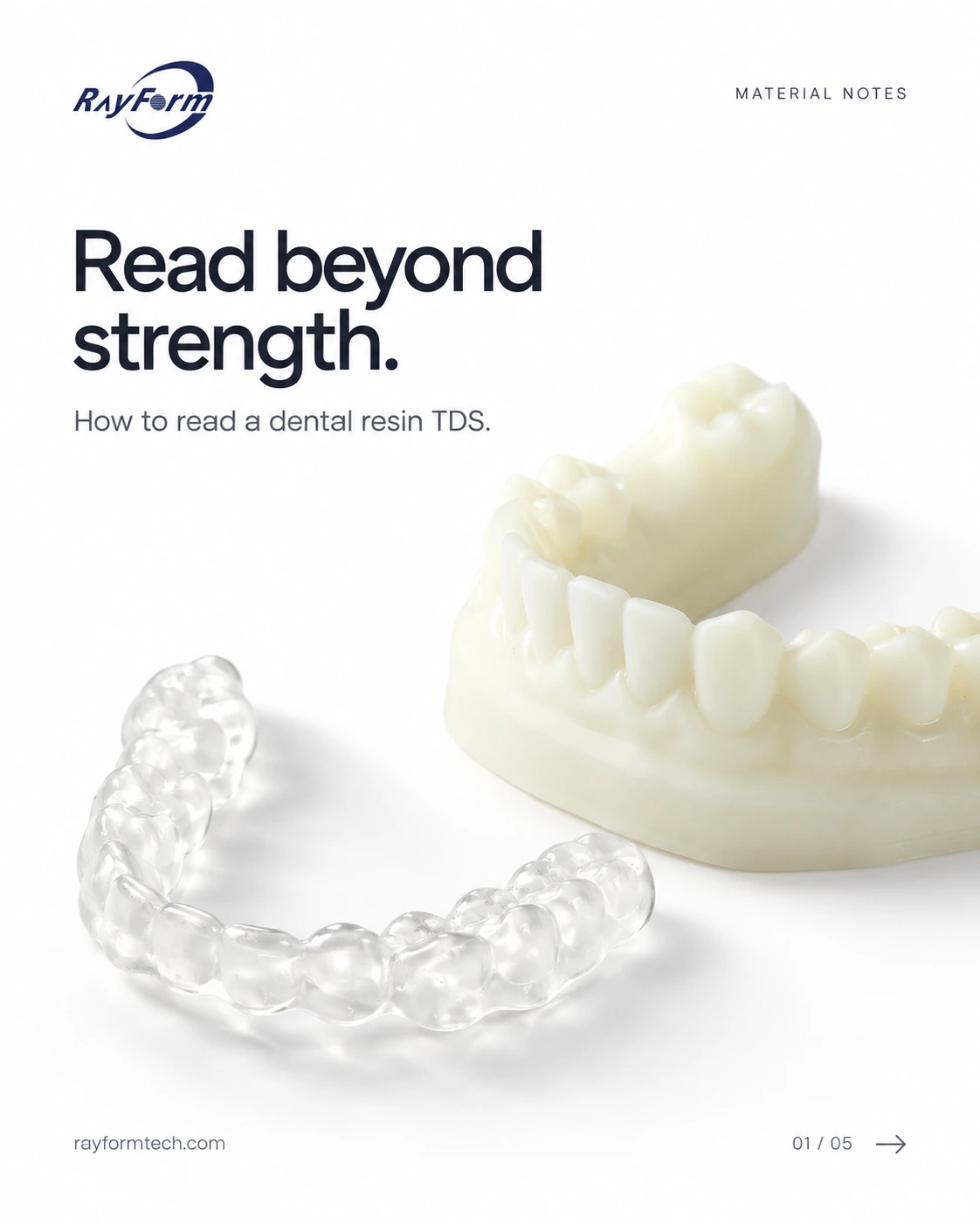
What should you check first on a dental resin TDS?
Start with the exact material name, product code, document revision and stated application. Then check the property being measured, its units, the test method and whether the specimen was post-cured. Record the printing, washing, curing and conditioning details before treating two values as comparable.
Keep the document set together. The TDS summarizes technical properties; the safety data sheet addresses hazards and safe handling; the applicable instructions for use describe the permitted process and application. A strength table does not replace these other documents.
For a RayForm material review, begin with the TDS and technical resources in the support center. If a detail needed for your comparison is absent, ask for the supporting method or processing instruction. Leave an unknown field marked as unknown.
Strength, stiffness and elongation answer different questions
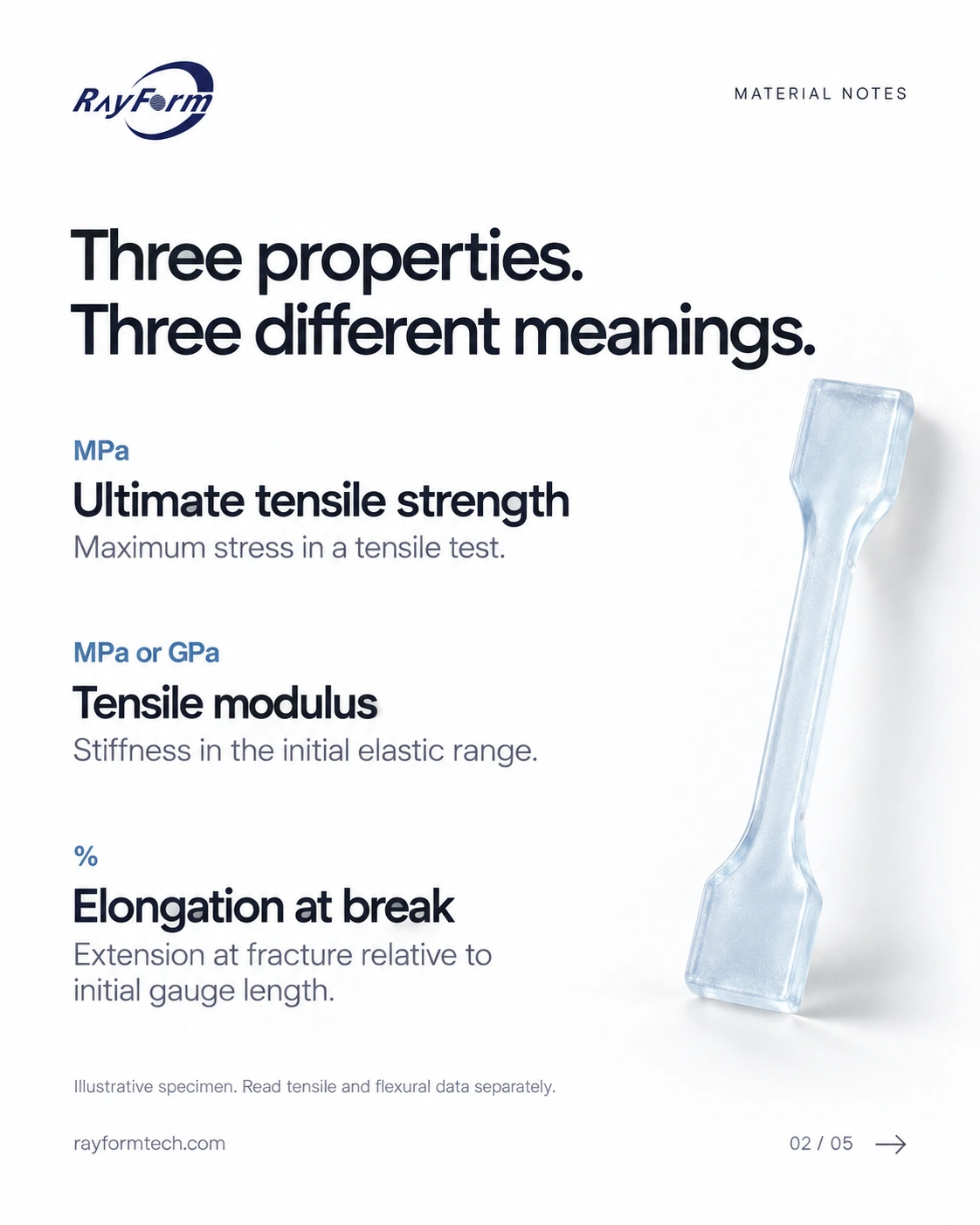
These three tensile properties describe different parts of a material's response to loading. Read the full property name, not just the number and unit. Instron's tensile-testing guide distinguishes maximum tensile stress, elastic stiffness and deformation relative to the original gauge length. [1]
| TDS property | What it describes | What it does not establish on its own |
|---|---|---|
| Ultimate tensile strength, usually MPa | The maximum engineering stress reached during a tensile test. It is not necessarily the stress at fracture. | Bending performance, repeated-load durability or finished-part accuracy. |
| Tensile modulus, usually MPa or GPa | Stiffness in the initial elastic region of the tensile response. | The maximum load before failure or how far a specimen can stretch before breaking. |
| Elongation at break, % | Extension at fracture relative to the specimen's original gauge length. | Elastic recovery, fatigue life or resistance to impact. |
When reviewing units, 1 GPa equals 1,000 MPa. Converting the unit helps compare the same property, but it does not make different properties equivalent.
For a purchasing discussion, translate each requirement into a question. Do you need a stiffer part under a defined load? Are you evaluating resistance to a particular type of failure? Is dimensional stability after processing the limiting issue? This prevents a discussion about “strength” from concealing several different requirements.
Can you compare tensile strength with flexural strength?
Both may be reported in MPa, but they come from different loading arrangements. Tensile testing stretches a specimen; flexural testing loads it in bending. ASTM D638 covers tensile properties of plastics, while ASTM D790 addresses flexural properties. [2][3]
Do not rank one resin's tensile result against another resin's flexural result. Also check whether both suppliers used the same standard edition, specimen geometry and test conditions. Matching units are only the first check.
Does a higher Shore hardness mean a tougher resin?
No. Shore hardness measures resistance to indentation. Impact resistance and fracture toughness require their own measurements; they cannot be read from a hardness value. [4] If your concern is chipping during handling or failure after repeated loading, ask for evidence relevant to that failure mode.
Read the conditions behind the number
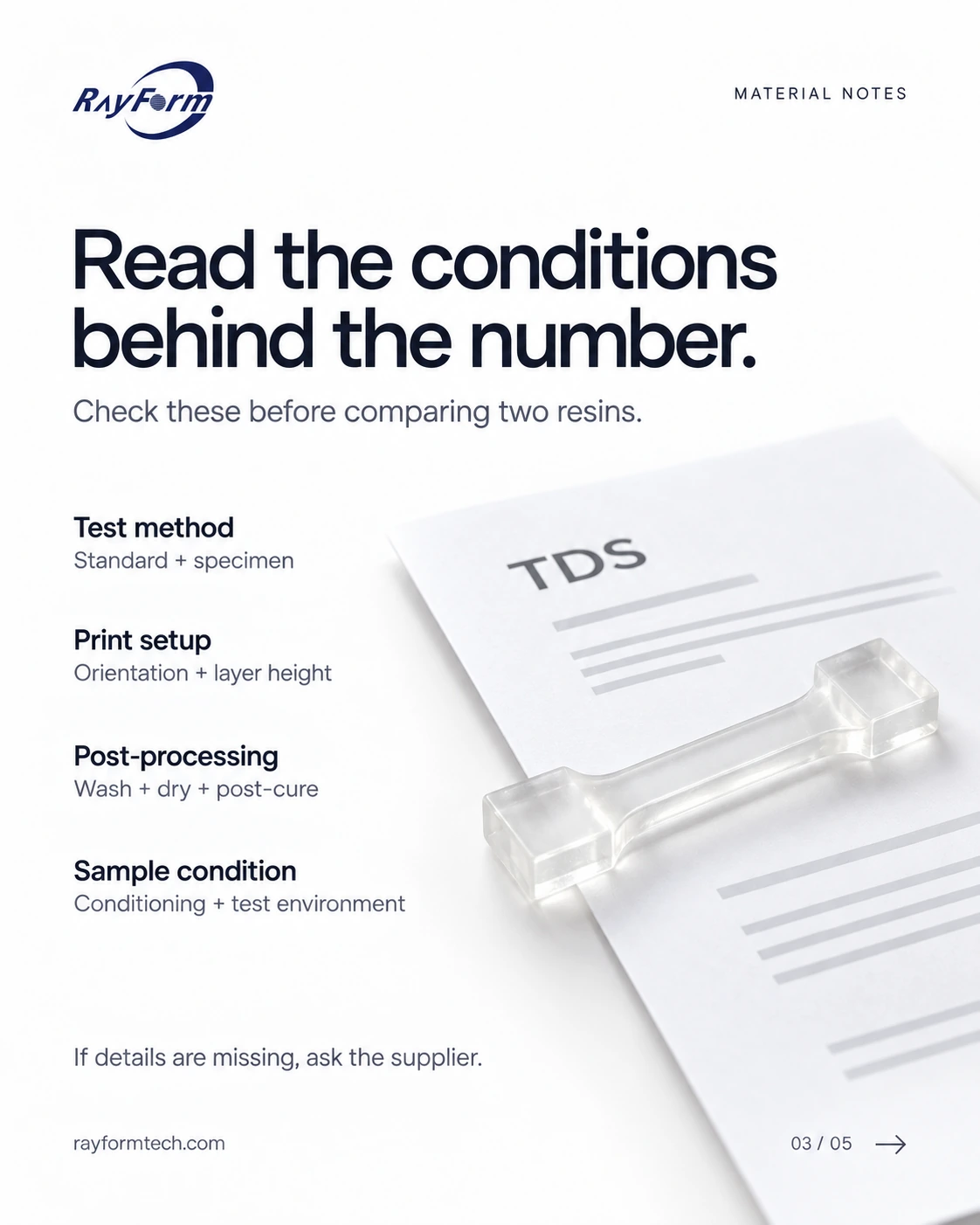
Use the footnotes as part of the data table. ASTM's tensile-testing guidance notes the importance of specimen preparation, test speed and environment when comparing results. [2] Before placing two results side by side, look for the following information:
- Test method: the standard, its edition, specimen type, test speed and reported result.
- Print preparation: the printer, material profile, orientation and layer height.
- Post-processing: washing medium and procedure, drying, curing device, time and temperature where specified.
- Sample condition: the time before testing, conditioning environment and any aging treatment.
If the TDS gives a range or a “typical” value, ask what that expression means for the supplied material. Do not silently convert a typical laboratory result into a guaranteed acceptance limit for every printed part.
Green and post-cured results belong in separate columns
“Green” generally identifies a printed part before the specified post-curing step, but read the supplier's definition. Formlabs' Precision Model Resin TDS, for example, describes its green specimens as washed and air-dried without post-curing. It reports green and post-cured properties separately and documents sample preparation in the footnotes. [5]
That is a useful example of transparent reporting. It is not a reason to apply the same curing settings to another resin. Compare specimens at equivalent processing stages, and follow the instructions for the material you intend to use.
What does the research tell us?
A 2025 study by Cheadle and colleagues in Scientific Reports examined print orientation and post-curing time and temperature using Formlabs Clear V4 resin, a Form 2 printer and a FormCure unit. The measured tensile and physical properties changed with the tested conditions. [6]
The practical lesson is to keep the preparation conditions attached to a reported result. The paper does not establish RayForm material properties, a universal curing schedule or one best orientation for every dental application.
A practical way to compare two resin data sheets
Create a record before ordering trial material. The table below is a proposed lab purchasing tool, not a standardized test protocol. Use it to identify gaps that a supplier or your trial must resolve.
| Comparison field | Record for each candidate | Question to resolve |
|---|---|---|
| Product identity | Exact name, SKU, revision and date | Are both data sheets current and matched to the supplied material? |
| Intended application | The use stated in the product documentation | Does it cover the part you plan to produce? |
| Required property | Full property name and unit | Are you comparing the same measurement? |
| Test method | Standard, edition and specimen details | Are the methods sufficiently comparable? |
| Processing state | Green, post-cured or other stated condition | Were both specimens tested at the same stage? |
| Printing conditions | Printer, profile, orientation and layer height | Which details are documented and which are missing? |
| Washing and drying | Medium, sequence and stated conditions | Can your lab reproduce the required steps? |
| Post-curing | Device and specified operating conditions | Is your available curing equipment covered? |
| Conditioning | Environment, duration and aging, if applicable | Do the results describe similar specimen histories? |
| Outstanding evidence | Missing documents or unresolved questions | What must be confirmed before the trial? |
Example of a comparison that is not ready: one data sheet lists post-cured flexural strength; the other lists tensile strength without stating the cure condition. The appropriate conclusion is “insufficient comparable information.” Ask for matching data before deciding which material performs better.
This prevents a common purchasing error: filling gaps with assumptions simply because both products are described as dental resins.
Connect the data sheet to your production workflow
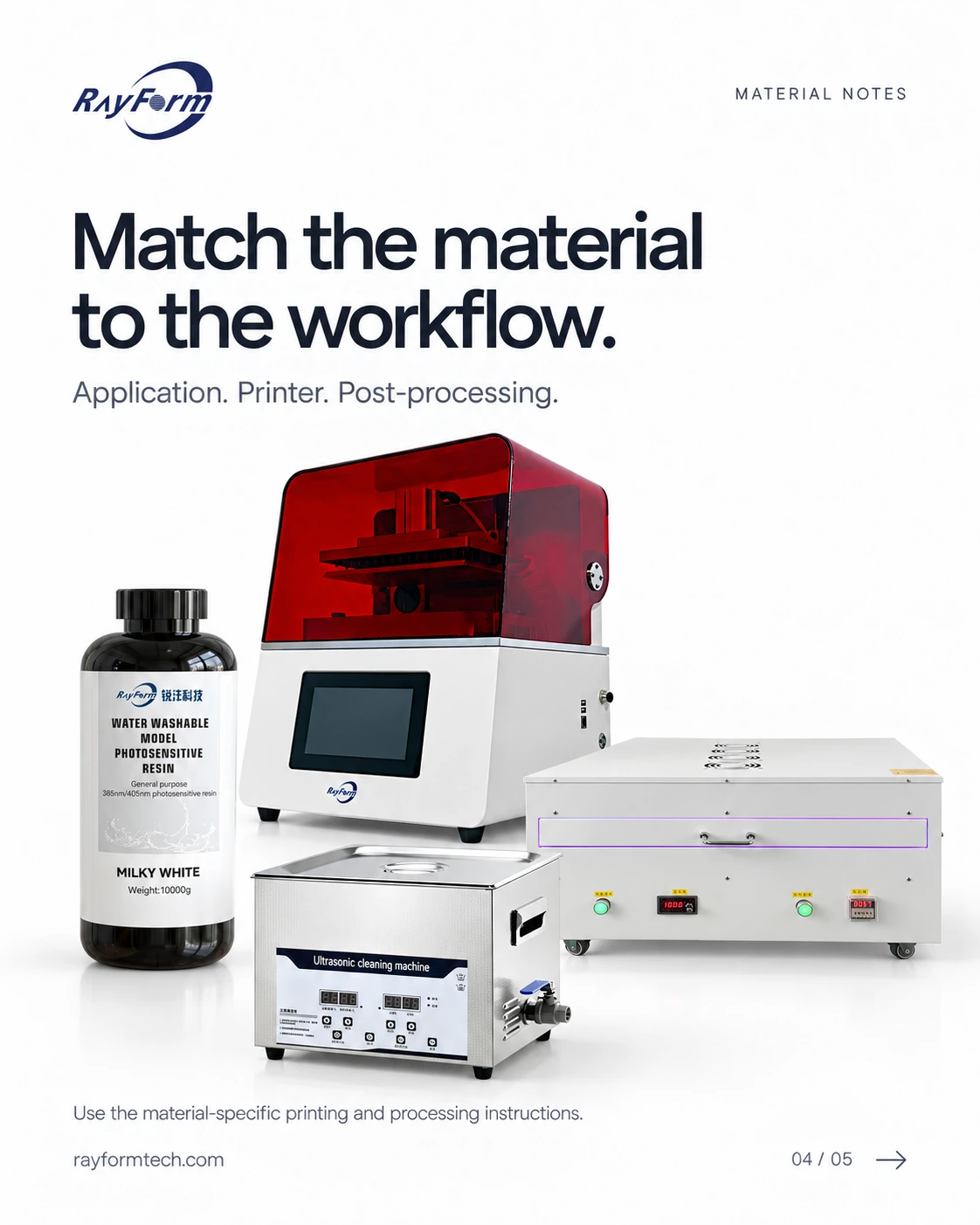
Once the documentary comparison is clear, define what a useful lab trial needs to answer. A test bar and a production model have different geometries. Your trial should address the actual features and handling steps that matter in your workflow, without being presented as a substitute for formal testing.
For a dental model workflow, a practical trial record might include:
- The exact printer, profile and resin batch used.
- The representative model geometry and the features selected for inspection.
- The documented washing, drying and post-curing sequence.
- Measurements or observations after the complete processing sequence.
- The inspection criteria, rejected parts and reasons for rejection.
Define the inspection method and acceptance criteria before comparing candidates. Repeat the evaluation enough to investigate the variability relevant to your production decision; one visually successful model cannot establish process repeatability.
RayForm's resin printing parameters and post-processing resources provide a place to check available material and printer information. Confirm that the entry matches the exact combination you intend to evaluate. If your machine or curing unit is not covered, ask for clarification instead of borrowing an unrelated profile.
Questions to send your material supplier
You can adapt this request for a lab purchasing review:
We are evaluating [material/SKU] for [application] on [printer model]. Please send the current TDS, applicable processing instructions and safety data sheet. For the properties relevant to this application, please identify the test methods, specimen preparation, post-curing and conditioning. Please also confirm which printing profile and curing equipment are documented for this combination, and identify any unresolved compatibility details.
Keep the response with the comparison record. It gives purchasing and production staff the same set of documents to work from.
Common questions about dental resin data sheets
Is the resin with the highest strength always the right choice?
No. First confirm the documented application, then evaluate the relevant properties and processing requirements. A high value from a different test or specimen condition does not establish a better result for your workflow.
Can I copy the curing schedule from a published paper?
Use the material-specific instructions for your process. A research paper describes its own material, equipment and experimental conditions; applying those conditions to a different resin requires separate supporting evidence.
What should I do if the TDS omits the test conditions?
Ask for the supporting method and sample-preparation details. Record the omission in your comparison. Do not invent a curing time, assume that a specimen was tested dry, or treat “not stated” as equivalent to another supplier's documented condition.
Start with the relevant documents
Review the RayForm dental printing resin range, then collect the TDS and processing information for the material that matches your application. To discuss a specific setup, send RayForm your application and printer model.
Keep three items together when making the decision: the material document, the process you intend to run and the evidence you still need.
References
[1] Instron. Tensile Testing: A Complete Guide to Principles, Equipment, and Standards. Definitions of tensile strength, modulus and strain. Read the guide.
[2] ASTM International. ASTM D638 — Standard Test Method for Tensile Properties of Plastics. Public scope reference; the exact edition used must be checked in each TDS. Standard information.
[3] ASTM International. ASTM D790 — Standard Test Methods for Flexural Properties of Unreinforced and Reinforced Plastics and Electrical Insulating Materials. Public scope reference. Standard information.
[4] ASTM International. ASTM D2240 — Standard Test Method for Rubber Property—Durometer Hardness. Public summary of indentation-based hardness and its limits. Standard information.
[5] Formlabs. Precision Model Resin Technical Data Sheet, Rev. 01, March 20, 2024. Used as an example of how processing conditions are reported, not as RayForm performance data. Official PDF.
[6] Cheadle AMGC et al. The impact of modifying 3D printing parameters on mechanical strength and physical properties in vat photopolymerisation. Scientific Reports 15, 12592 (2025). DOI: 10.1038/s41598-025-97294-8. Publisher record · Open-access author-institution copy.
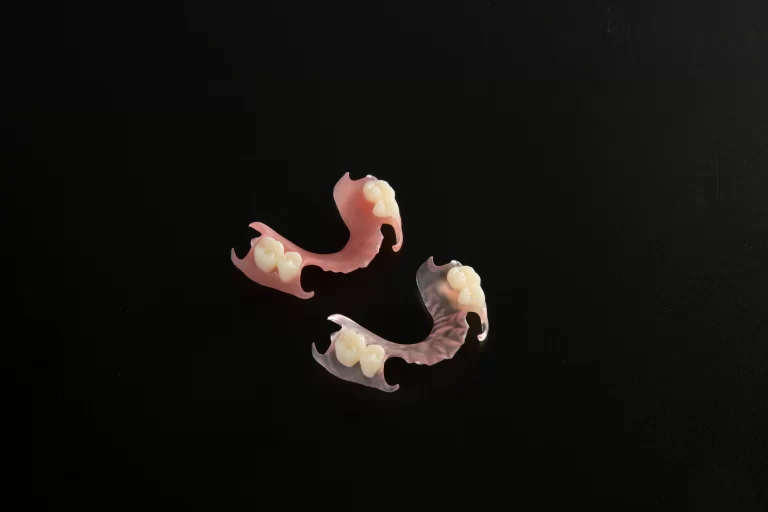
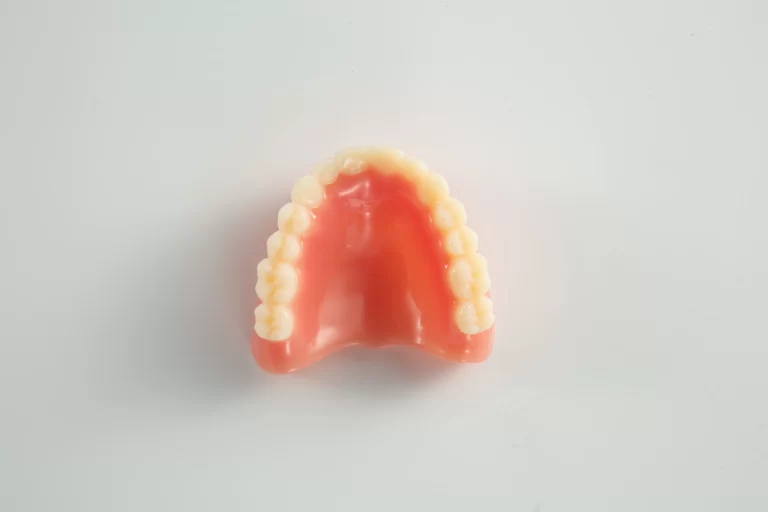
The accompanying images are educational AI compositions based on RayForm product references. The illustrated specimens and equipment arrangements are not test results or evidence of a qualified production combination.