Water-Washable Dental Model Resin: Cleaning and Dimensional Stability
Water-washable dental model resin allows a water-based cleaning route where the material’s instructions specify one. A laboratory still needs to assess the complete printing and post-processing workflow. Published studies examine several different outcomes: surface condition, deviation from a digital design, the position of a seated removable die, and changes during storage. A favourable result in one does not establish the others. [1] [2] [3] [5]
For a lab evaluating a material, the practical questions are straightforward: which features must the model reproduce, how will those features be checked, and when will the model be used? Those questions help turn a resin trial into useful production evidence.
Start with the material’s washing and drying instructions
“Water-washable” describes a cleaning capability. It does not specify a complete procedure for every printer, model geometry or curing unit.
Phrozen’s guide for its Water-Washable Dental Model Resin describes ultrasonic cleaning in water, drying and a post-curing procedure linked to specified equipment. RayForm’s RF-ZJ-02 TDS also describes water cleaning, thorough blow-drying and removal of supports before post-curing. These are material-specific documents; their settings should be read in that context. [5] [6]
Before a trial, identify the applicable document and revision. Record the washing liquid, equipment and duration, the drying method, and the curing unit and program actually used. If a proposed combination is not covered by the available instructions, ask the supplier what documentation applies before treating it as a production procedure.
Changing several steps together makes the result harder to interpret. Keep a record of each change so that a different result can be investigated without guessing which material or process condition was used. For more on the curing part of that record, see Dental Resin Post-Curing: Why Time Alone Is Not Enough.
Decide which outcome you need to measure
The word “accuracy” can hide different questions. The distinctions below follow the measurements used in the reviewed studies. They help a lab choose relevant checks or request appropriate supplier reports; they do not require every lab to reproduce every research test. [1] [2] [3] [4]
| Outcome | What the measurement asks | What it does not establish on its own |
|---|---|---|
| Surface condition | How rough or hard is the tested surface? | Whether the full arch matches the digital design. |
| Dimensional trueness | How closely does the printed geometry match its reference? | Whether a removable die occupies the intended position after seating. |
| Positional trueness | Where does the die sit within its matching cast? | Whether that position remains unchanged during storage. |
| Dimensional stability | How do repeated measurements compare over a defined storage period? | Performance under other storage conditions or for every application. |
Surface quality and model dimensions need separate evidence
Çakmak and colleagues tested disk-shaped specimens from two water-washable cast resins and one non-water-washable cast resin. They measured surface roughness and Vickers microhardness after different cleaning procedures. Within each of the two water-washable resins, the cleaning solutions did not produce statistically significant differences in measured roughness. Hardness responses depended on the material–cleaning combination. [3]
Those findings concern the tested surfaces. They do not demonstrate equivalence between all cleaning methods, or establish the dimensional trueness of a complete dental model.
Burde and colleagues instead compared 30 full-arch models made with three Phrozen resins on one Sonic Mini 8K S printer. The water-washable group had the lowest mean root mean square (RMS) deviation from the reference design under the tested conditions. However, exposure, dimensional compensation, cleaning and post-curing duration also varied between groups. All groups used the same Phrozen Cure V2 unit. [4]
That is evidence about specified material and process combinations. It cannot isolate water cleaning as the cause of a lower deviation, nor does it establish storage stability. When comparing a supplier’s accuracy claim, ask for the accompanying printer profile and post-processing conditions.
Check a removable die both individually and after seating
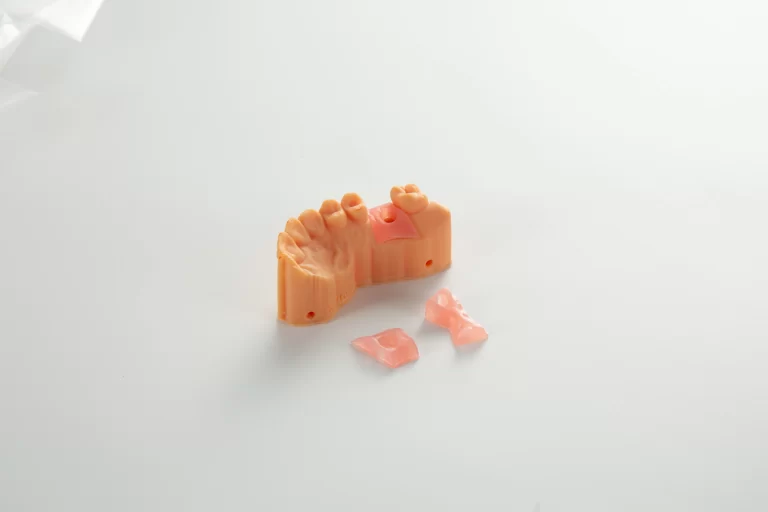
Seifert and colleagues measured removable dies on their own and after insertion into matching partial-arch casts. The study distinguished dimensional deviations in different die regions from positional deviations after seating; it also used separate surface-based and point-based positional measurements. [2]
These measures did not give one interchangeable ranking of the tested combinations. For a removable-die workflow, inspecting the individual part and checking its seated position address different questions.
The experiment used a fixed design and limited corresponding cast replication, and it did not assess long-term storage. Its results therefore support a more specific evaluation of die fit, rather than a universal acceptance limit. [2]
Check the model at the time it will be used
A measurement soon after fabrication answers a different question from a measurement after storage.
Lammer and colleagues printed 72 maxillary casts using three resins and three cleaning solutions, with eight casts per material–cleaning combination. They stored the casts in light-proof boxes at 23°C and scanned the same casts at one day, one week, two weeks, three weeks and three months after fabrication. The first measurement was at one day, not immediately after printing. [1]
The study analysed different regions. Its entire-arch results concern the tooth-bearing arch region, while entire-cast results include the soft-tissue surface. Figure 1 uses the entire-arch values from Table 5. Each point represents deviation from the original reference STL, not change relative to that cast’s first scan. [1]
Figure 1. Selected material–cleaning combinations, redrawn from Lammer et al., Table 5. Points show mean entire-arch deviation from the reference STL; error bars show SD, with n = 8 casts per combination. The same casts were measured repeatedly during storage at 23°C in light-proof boxes. The first occasion is one day after fabrication; the last is three months. Occasions are equally spaced on this categorical axis, although elapsed time intervals are not equal. The water-washable and non-water-washable materials used different post-curing units, so this is a comparison of tested workflows. Data source: DOI 10.1016/j.jdent.2025.105908, CC BY 4.0. [1]
The selected combinations show different mean deviation levels and time courses. The EPAX–water mean does not rise at every successive occasion, and the KeyModel Ultra–IPA means remain relatively close together. These observations describe the plotted group means; they do not establish equivalence, or make every time-point difference statistically significant. Significance must be read from the study’s comparisons, not inferred from overlapping error bars. [1]
For production planning, decide when the model needs to remain usable and check it at relevant intervals under recorded storage conditions. This experiment supplies evidence for specific combinations in a controlled environment. It does not validate three-month storage for an untested resin, a different model design, or another storage environment.
Make a material trial traceable
The following is an editorial trial-record checklist, informed by the variables and limitations in the studies. It is not a validated test standard or a universal printing recipe. Select checks appropriate to the intended job and the measuring equipment available to your lab. [1] [2] [3] [4]
| Record | What to capture |
|---|---|
| Material identity | Product, version, shade, batch and intended model application. |
| Printing setup | Printer, profile, layer thickness, orientation, compensation and support arrangement. |
| Cleaning and drying | Liquid, washing equipment, duration, drying method and the applicable manufacturer instructions. |
| Post-curing | Unit, program and the procedure used for that material. |
| Geometry and fit | Reference file, measured regions, inspection method and, where relevant, the die-seating procedure. |
| Storage and timing | Conditions, elapsed time after fabrication and when each measurement was taken. |
| Decision and changes | Application-specific acceptance criteria, observed defects, repeat results and any process changes. |
Keep the reference file and inspection method consistent when comparing trials. For a removable-die model, record the individual geometry and the seated result separately. If models will be stored, add a repeat check at the planned time of use rather than relying only on the first inspection.
The reviewed work remains a small body of laboratory evidence. Several papers share researchers and material systems. Their findings are useful for identifying what to check, but should not be treated as independent validation of every water-washable resin or workflow.
Review the documentation for your RayForm material
RF-ZJ-02 is RayForm’s Water Washable Dental Model Resin. Start with its product information and current technical document, then check which available printer and processing information applies to your setup. The studies discussed above tested other manufacturers’ materials; they do not establish RF-ZJ-02 accuracy or storage performance. [6]
When contacting RayForm, include the material, intended model application, printer and curing unit, together with your washing and drying sequence. This gives a clearer basis for identifying the relevant documentation.
References
This is a focused literature commentary, not a systematic review. The cited full texts and manufacturer documents were checked on 26 October 2026. The trial-record checklist is an editorial recommendation.
- Lammer CA, Dönmez MB, Çakmak G, Kahveci Ç, Yilmaz B. Does ecologically sustainable printing and postprocessing enable dimensionally stable dental casts? Journal of Dentistry. 2025;161:105908. DOI: 10.1016/j.jdent.2025.105908. Figure 1 uses selected data from Table 5, redrawn under CC BY 4.0.
- Seifert AP, Molinero-Mourelle P, Cakmak G, de Paula MS, Kahveci Ç, Yilmaz B, Dönmez MB. Additively manufactured water-washable resin dies cleaned with nonhazardous solutions: Can dimensional and positional trueness be ensured? Journal of Prosthodontics. Published online 2025. DOI: 10.1111/jopr.70073. The abstract and Methods report different overall specimen totals; that total is not used here.
- Çakmak G, Sabatini GP, de Paula MS, Orgev A, Kahveci Ç, Revilla-Léon M, Yilmaz B. Can nonhazardous postprocessing cleaning solutions enable adequate surface properties for printed dental casts in different resins? The Journal of Prosthetic Dentistry. 2025;133(3):893–902; first published online 2024. DOI: 10.1016/j.prosdent.2024.07.034.
- Burde AV, Manole MC, Baciu S, Cretu SG, Sinescu C. Dimensional Accuracy of Dental Models Printed with Different Resins Using a Low-Cost LCD 3D Printer. Medicine in Evolution. 2026;32(1):49–58. DOI: 10.70921/medev.v32i1.2029.
- Phrozen. Phrozen Water-Washable Dental Model Resin User Guide. Official PDF. Nine-page guide; no explicit revision date identified. Instructions apply to the specified material and equipment.
- RayForm. RF-ZJ-02 Resin Technical Data Sheet, V1.0a, English. Official PDF. Used for product identity and documented processing information, not as evidence of the performance measured in the external studies.