
Material selection guide · Dental lab production
PETG vs PETG + TPU Thermoforming Sheets for Aligners and Retainers
Choosing an aligner sheet is not a contest between two polymer names. A dental lab buys a formed-part process: sheet construction, nominal thickness, model geometry, thermoforming equipment, heating cycle, cutting method and inspection rules all work together.
PETG or PETG + TPU: the short answer
Choose single-layer PETG when your validated workflow calls for a straightforward PETG sheet for retainers or forming templates. Evaluate multilayer PETG + TPU when the listed use covers an aligner, attachment template, or retainer. The final choice still needs a controlled trial with your own thermoforming machine, model geometry, trimming process and acceptance criteria.
There is no material label that can replace this trial. Research on commercial aligner sheets reports different stress-relaxation behavior across products, but the tested samples also differed in composition and thickness.[2] That makes the research useful for asking better qualification questions, not for declaring one construction universally superior.
PETG vs TPU aligner sheets: why the shortcut can mislead
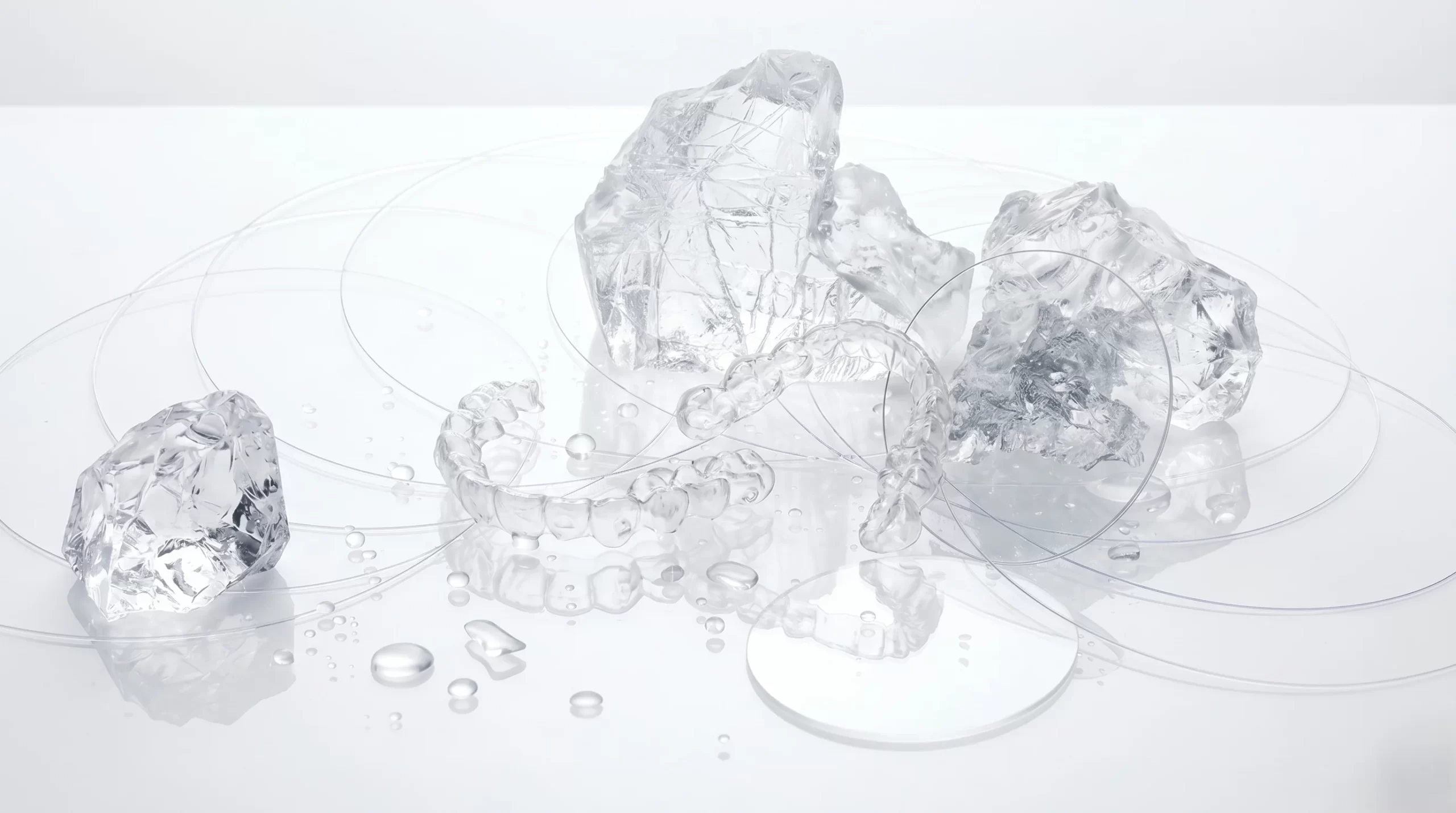
PETG is glycol-modified polyethylene terephthalate, a polyester widely used in dental thermoforming sheets. TPU is thermoplastic polyurethane. Yet a search for “PETG vs TPU aligner sheets” can hide a third, commercially important category: a multilayer sheet that combines PETG and TPU.
That distinction matters because “multilayer” is not a standard recipe. Layer count, sequence, thickness distribution, resin grade and bonding method can vary by product. One manufacturer’s IFU, for example, describes a hard PETG side and a soft TPU side.[7] RayForm’s current brochure identifies FLEX and DURA as multilayer PETG + TPU, but it does not publish a specific layer order. A lab should use each supplier’s exact document rather than infer a construction from a generic diagram.
The same caution applies to simplified claims such as “PETG is rigid” or “TPU is flexible.” Those statements describe broad polymer tendencies, not the behavior of a finished appliance. Commercial formulation, thickness, forming history and geometry can change the result.
Questions that are more useful than “Which polymer is best?”
- Is the sheet explicitly listed for the appliance being produced?
- What is the exact single-layer or multilayer construction supplied?
- Does the format fit the lab’s thermoforming machine and fixture?
- What happens to thickness and adaptation after forming?
- Can operators trim and finish it consistently across a test batch?
- Can the lab trace the lot, package and parameter version?
Single-layer PETG vs multilayer PETG + TPU at a glance
The table below describes RayForm’s own sheet range, not every PETG or multilayer product on the market. Construction and listed uses come from the current RayForm product brochure.[1]
| Series | Construction | Brochure-listed uses | Thicknesses | Formats | Packaging |
|---|---|---|---|---|---|
| CLEAR | Single-layer PETG | Retainers / Templates | 0.50, 0.75, 1.00 mm | Round Ø125 mm Square 125 × 125 mm |
220 pcs per foil bag |
| FLEX | Multilayer PETG + TPU | Attachments / Aligners | 0.50, 0.75, 1.00 mm | Round Ø125 mm Square 125 × 125 mm |
20 pcs per foil bag |
| DURA | Multilayer PETG + TPU | Aligners / Retainers | 0.50, 0.75, 1.00 mm | Round Ø125 mm Square 125 × 125 mm |
20 pcs per foil bag |
For product photos, full specifications and the official brochure, compare RayForm FLEX, DURA and CLEAR sheet specifications. The RayForm Support Center also provides the brochure download.
Where each RayForm series enters a lab evaluation
CLEAR
Single-layer PETG
Include it in a sample trial when the production requirement is a retainer or forming template and the approved specification calls for single-layer PETG.
FLEX
Multilayer PETG + TPU
Include it when the listed use is an attachment template or aligner and the project calls for a multilayer sheet.
DURA
Multilayer PETG + TPU
Include it when the production scope covers aligners, retainers or both and a multilayer construction is being evaluated.
When intended uses overlap, run the candidates side by side. Keep the model, equipment, parameter version, operator instructions and inspection method constant. This shows whether a difference comes from the sheet trial rather than a moving production variable.
Why post-thermoforming behavior matters more than the raw sheet label
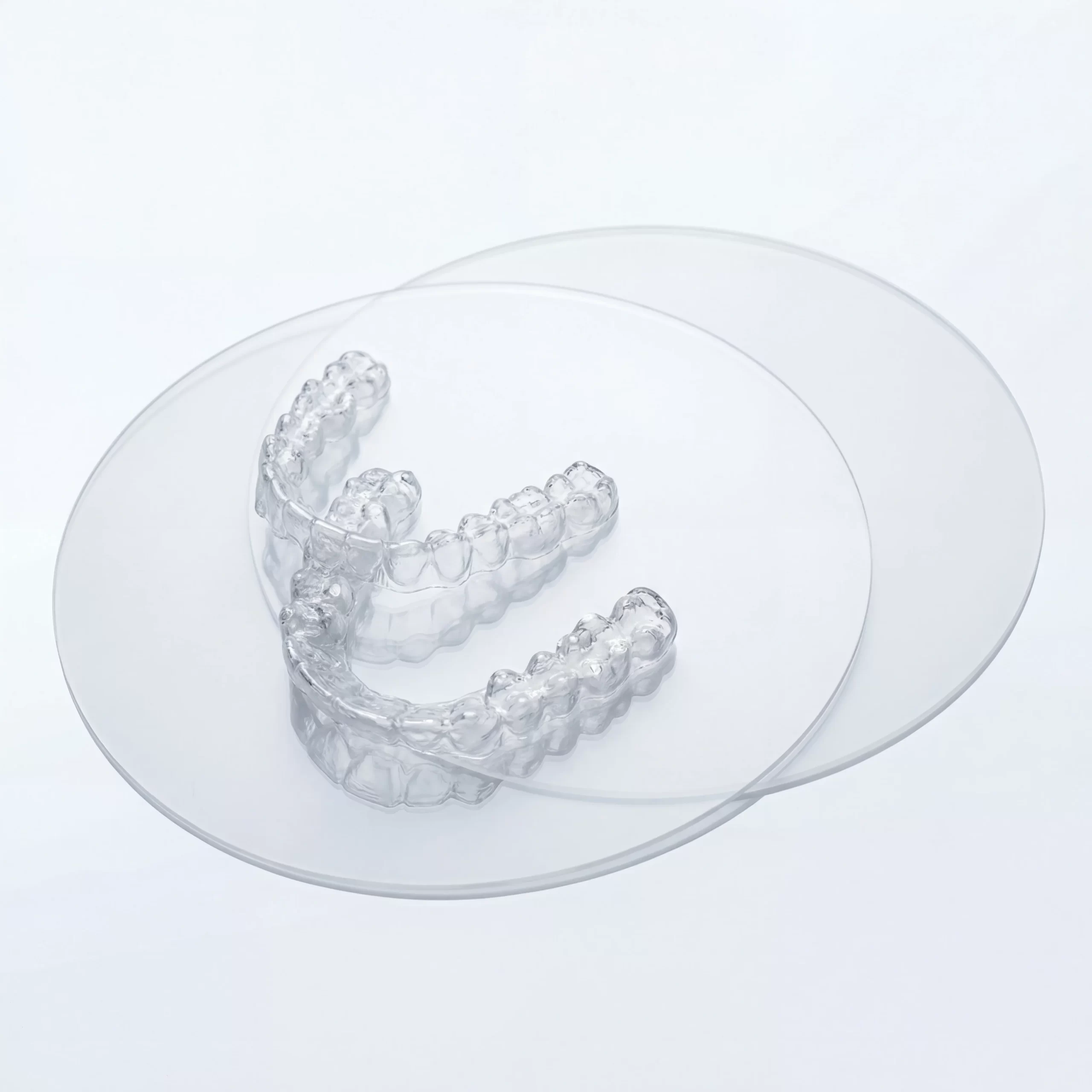
A specification sheet describes the material before it passes through your full workflow. Thermoforming changes its geometry and can change other measured properties.
In a multi-material study, Ryu and colleagues found that thermoforming affected transparency, water-related behavior, hardness and mechanical measurements, with the direction and scale varying by material and thickness.[3] A separate PETG study reported reduced specimen thickness and a large increase in surface roughness after thermoforming under its test conditions, while its measured mechanical properties stayed almost unchanged.[4] These are not contradictory instructions for a lab. They show why results must be tied to the tested product, geometry and method.
Even two commercial PETG products did not respond identically in a study of thermoforming and simulated aging.[5] A 2026 nano-CT pilot study also found that sheet type, thermoforming machine and tooth region interacted with formed thickness and gap measurements.[6] The practical lesson is simple: nominal thickness is an input; the formed appliance is the object that needs inspection.
Five variables to hold constant during a comparison
- Reference model: use the same approved model file, print orientation and post-processing route.
- Thermoforming equipment: use the same machine, fixture and maintenance state.
- Parameter version: begin with the material and equipment instructions, then document every approved adjustment.
- Cooling and removal sequence: keep the timing and operator steps consistent.
- Inspection method: measure and score the same locations and defects for every sample.
An application guide from Formlabs makes the same process connection: it advises starting with settings recommended for the equipment and sheet, and it notes that model preparation, model height, heating cycle, thickness and material brand can affect the formed result.[8] Treat those observations as workflow principles. Do not copy a temperature or time from an unrelated machine-material combination.
Seven checks before changing clear aligner sheet material
-
Confirm the intended production use
Start with the appliance specification. Do not choose a sheet only because its polymer name looks familiar. Confirm that the supplier lists the intended use, then retain the supporting document with the material record.
-
Check machine and sheet-format compatibility
RayForm sheets are available as Ø125 mm rounds and 125 × 125 mm squares.[1] Match the format to the holder and usable forming area, not only to the nominal machine category. Confirm that clamps, frames and protective films can be handled without improvised steps.
-
Control model preparation
A sheet trial cannot compensate for tacky, distorted or poorly cleaned models. Use one documented print and post-processing route. Formlabs notes that incompletely washed or post-cured models can adhere to thermoforming material.[8] Regardless of printer brand, model readiness should be an explicit release step before forming.
-
Qualify the forming window
Use the supplier and machine instructions as the starting point. Record the selected program, thickness, cycle and any approved change. Never assume that two sheets with the same nominal thickness require the same process setting.
-
Inspect the formed part, not only the blank
Define inspection sites before testing. Record adaptation, visible folds, bubbles, incomplete forming and thickness at the same locations. The research evidence shows that forming can change thickness and surface condition.[3][4][6]
-
Test trimming and edge-finishing repeatability
Use the same cutting route and finishing tools for each candidate. Track operator time, edge consistency and visible heat damage. If automation is used, freeze the cutting program version during the comparison.
-
Preserve batch and packaging traceability
Record series, nominal thickness, format, lot, package opening date and storage condition. Packaging is part of the material-control plan: FLEX and DURA are supplied as 20 pieces per foil bag, while CLEAR is supplied as 220 pieces per foil bag.[1] Follow the product-specific storage instructions; moisture sensitivity and resealing rules can differ between sheet products.[7]
A practical sample-qualification matrix for dental labs
Use a small controlled batch before changing a production material. Set acceptance rules before seeing the result; otherwise, the test becomes a subjective product demonstration.
| Qualification field | What to record | Acceptance rule |
|---|---|---|
| Material identity | Series, construction, thickness, format, lot | Matches purchase and supplier documents |
| Reference model | File revision, printer, resin, build and post-process route | Same released model route for all candidates |
| Forming setup | Machine, fixture, program and parameter revision | Approved setup; no undocumented adjustment |
| Formed thickness | Defined measurement sites and method | Meets the lab’s pre-set appliance specification |
| Adaptation | Same visual or measurement check on each sample | No defined reject condition |
| Visible defects | Bubbles, folds, incomplete forming, contamination | Within the lab’s written defect limit |
| Cutting and finishing | Method, program, operator time, edge result | Repeatable result without out-of-rule damage |
| Trial repeatability | Results across the planned sample count | Meets the pre-set pass rate |
| Disposition | Approve, revise and retest, or reject | Signed against the current SOP version |
The sample count and acceptance limits must come from the lab’s quality system and appliance requirements. This guide intentionally does not invent universal values.
A fair way to compare two candidate sheets
Run candidate A and candidate B on the same reference model and the same machine. Alternate the run order when practical, and record each cycle rather than averaging away a defect. If the first trial suggests a parameter change, document it and start a new comparison round. Do not quietly tune one candidate while leaving the other on its starting setting.
This method produces a usable process record. It also gives procurement, production and quality staff the same evidence when discussing price, packaging, change control and supply.
When sheet selection becomes a production-system question
Material choice is one station in the clear-aligner workflow. As volume rises, model flow, forming capacity, identification, cutting, inspection and rework control become linked. A sheet that passes a single manual cycle still needs a repeatable path through the intended production setup.
If your project includes equipment and process design as well as material selection, see the full RayForm clear aligner production workflow. Keep the article-level decision clear: qualify the sheet first, then evaluate how the approved material moves through the wider production system.
Buyer and lab questions
Frequently asked questions
Is PETG or PETG + TPU better for clear aligner sheets?
Neither construction is universally better. The correct choice depends on the product’s listed use, exact construction, thickness, forming equipment, model geometry and acceptance rules. Compare formed samples under controlled conditions instead of choosing from the polymer name alone.
What is the difference between single-layer PETG and multilayer PETG + TPU sheets?
Single-layer PETG uses one PETG construction. A PETG + TPU multilayer sheet combines the two polymer families in a bonded construction. Exact layer order and thickness distribution can vary by product, so use the supplier’s current specification rather than a generic diagram.
Which RayForm series uses single-layer PETG?
RayForm CLEAR is the single-layer PETG series. The current brochure lists it for retainers and templates.[1]
Which RayForm sheets contain PETG and TPU?
RayForm FLEX and DURA are listed as multilayer PETG + TPU. FLEX is listed for attachments and aligners; DURA is listed for aligners and retainers.[1]
What thicknesses and formats are available?
FLEX, DURA and CLEAR are available in 0.50, 0.75 and 1.00 mm, in Ø125 mm round and 125 × 125 mm square formats.[1] These options are not a universal thickness-to-appliance prescription. Select against the approved appliance specification and production SOP.
How should a dental lab qualify a new thermoforming sheet?
Use the same released model, machine, parameter version, cooling sequence and inspection method. Record formed thickness, adaptation, visible defects, cutting and finishing across a defined sample batch. Set pass/fail rules before testing, then approve, revise or reject the process in writing.
Sample qualification
Compare samples in your own thermoforming setup
RayForm supplies single-layer PETG and multilayer PETG + TPU options in round and square formats. Compare FLEX, DURA and CLEAR under your own machine, model and production requirements.
References
- RayForm Technology. Clear Aligner Material — Product Brochure (Specifications Included). Official PDF.
- Lombardo L, Martines E, Mazzanti V, et al. Stress relaxation properties of four orthodontic aligner materials: A 24-hour in vitro study. The Angle Orthodontist. 2017. Full text.
- Ryu JH, Kwon JS, Jiang HB, Cha JY, Kim KM. Effects of thermoforming on the physical and mechanical properties of thermoplastic materials for transparent orthodontic aligners. Korean Journal of Orthodontics. 2018. Full text.
- Staderini E, Chiusolo G, Guglielmi F, et al. Effects of Thermoforming on the Mechanical, Optical, Chemical, and Morphological Properties of PET-G: In Vitro Study. Polymers. 2024. Full text.
- Dalaie K, Fatemi SM, Ghaffari S. Dynamic mechanical and thermal properties of clear aligners after thermoforming and aging. Progress in Orthodontics. 2021. Full text.
- Measurement of Aligner Thickness and Gap Width in Two Types of Clear Aligner Sheets Manufactured Using Two Different Thermoforming Machines — A Nano-CT Pilot Study. 2026. Full text.
- Erkodent Erich Kopp GmbH. Instruction for Use: Erkoloc-pro. Official PDF.
- Formlabs Dental. Application Guide: Manufacturing Thermoformed Clear Aligners and Retainers on 3D Printed Models. Application guide.
Editorial note: This article is production and procurement guidance for professional dental manufacturing. Product selection must follow the applicable appliance specification, supplier documentation and the laboratory’s approved quality procedures.