
The 23rd Seoul International Dental Exhibition & Scientific Congress (SIDEX 2026) runs May 29 to 31 at COEX in Seoul, covering 19,845 m² and hosting more than 300 exhibitors across roughly 1,100 booths[1]. Three days, multiple halls, and over 2,000 international participants — even with a tight plan, most visitors leave wishing they had filtered better before they arrived.
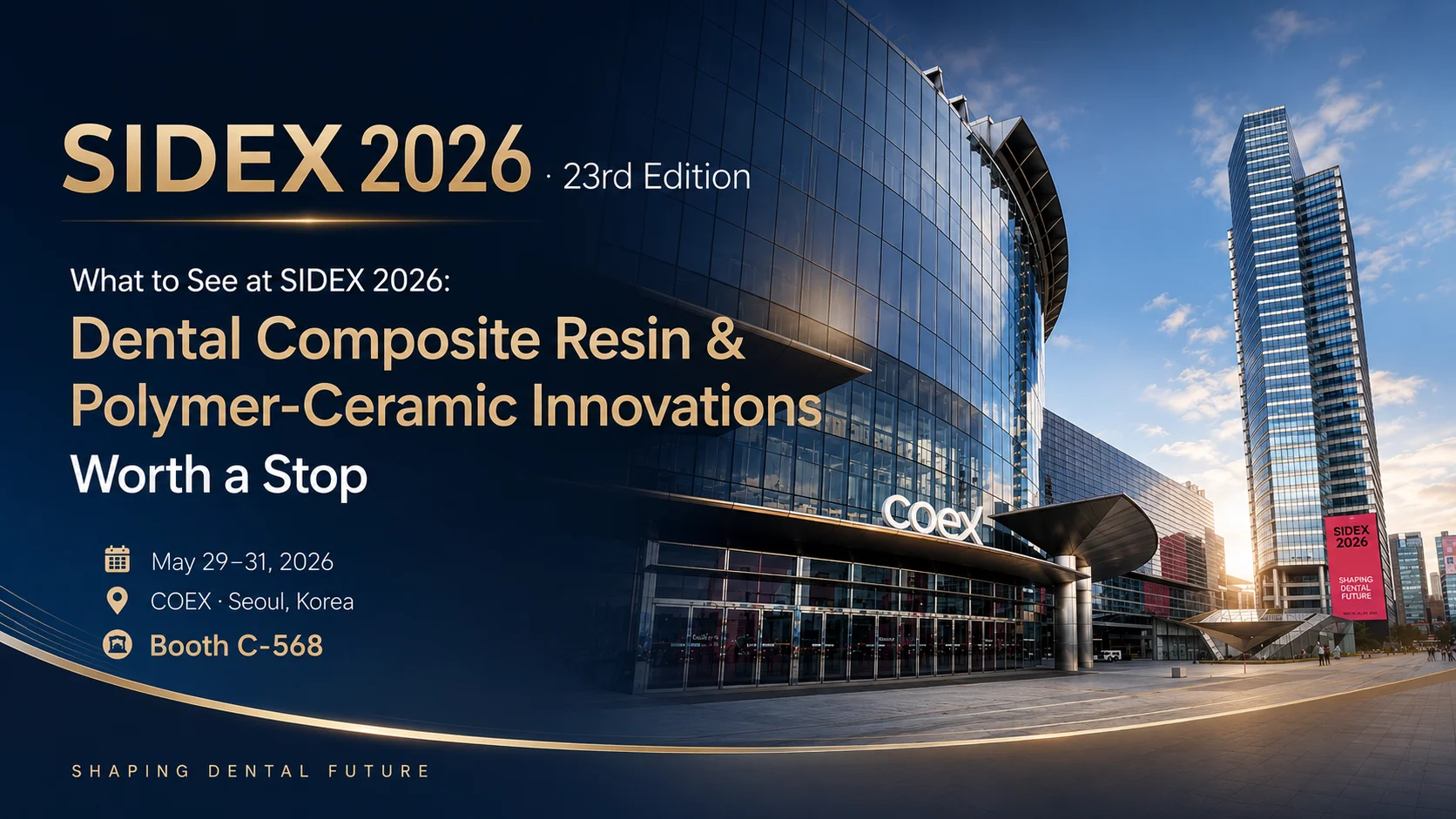
This guide is built for that filter, written specifically for dentists and dental laboratories whose work touches restorative composite, shade matching, and modern polymer-based materials. The focus is not on what is loudest at SIDEX 2026, but on the categories quietly moving forward and worth a chair-side test under daylight — not under booth spotlights.
RayForm will be at Booth C-568 with our Ceraform polymer-ceramic system and polychromatic tints, but this article is about the broader picture: the things any restorative-focused visitor should put on their map before stepping onto the exhibition floor. If you want to skip ahead, you can book a 30-minute slot at our booth directly.
SIDEX 2026 at a Glance
SIDEX is organized by the Seoul Dental Association and managed by the SIDEX 2026 Organizing Committee, with support from the Korean Dental Association, the Ministry of Trade Industry and Resources, and KOTRA[1]. The 2026 edition commemorates the 101st anniversary of the Seoul Dental Association, with the Scientific Congress running May 30 and 31 in parallel to the three-day exhibition[1].
Fri to Sun · 3 exhibition days
Exhibit categories span unit chairs, implant dentistry, radiography, sterilizers, and consumables — broad enough that a structured pre-visit plan saves hours of walking.
Why the Restorative Composite Category Is Quietly Evolving
For two decades, nanohybrid composites have been the workhorse of direct restoration. They are predictable, well-documented, and supplied by almost every major dental manufacturer. But three pressures have been pushing the category forward in 2025–2026:
Daylight color stability matters more than operatory color match. Patients increasingly photograph their restorations under natural light, and the gap between “looks fine in the chair” and “looks fine on the patient’s phone” has become a measurable source of remakes.
Wear behavior against natural enamel is back in the conversation. Restoration longevity now competes with implant longevity as a quality marker, and abrasive composites are losing favor.
Polishing efficiency is being measured. Labs and chairside clinicians are tracking polish time as a cost-per-restoration variable, not just an aesthetic afterthought.
These three pressures have pulled a category that was once positioned as a premium niche — polymer-ceramic composites — closer to the mainstream. They typically blend a methacrylate matrix with a higher ceramic filler load and a different particle morphology than classic nanohybrids, with trade-offs and benefits that are worth seeing in person. SIDEX 2026 is a useful place to evaluate them side by side, because it brings Korean, Japanese, Chinese, and European composite manufacturers under one roof.
5 Things Restorative Dentists & Labs Should Prioritize at SIDEX 2026
Polymer-Ceramic Composites for Anteriors
The most interesting movement at SIDEX 2026 is happening in the polymer-ceramic restorative composite category. Compared with nanohybrids, polymer-ceramic systems generally aim for higher gloss retention, reduced wear against opposing enamel, and a layered translucency profile that holds up under shifting light conditions.
What to ask at any composite booth: how does the material handle wet-on-wet layering in 1.5 mm increments, what is the manufacturer’s typical polish-to-luster time using standard wheels, and is the shade system designed for daylight or for operatory light. Bring a fresh A1 disc, ask for a small layered demo, and check the result outside the booth’s overhead lighting if you can.
RayForm will demo Ceraform Crown Shades — our light-curing polymer-ceramic composite — at Booth C-568, with A1 and the full crown shade range in 4 g syringes. The booth is set up for hands-on layering rather than slideshow demos.
Polychromatic Tints & Shade Modifiers
Tints — surface stains applied after the final composite layer — are how most experienced clinicians close the last 10% of the daylight color gap. Yet they are often skipped in vendor demos because they take longer to set up and require artistic judgement to evaluate.
At SIDEX 2026, look for tint systems that include both crown shade modifiers (whites, ambers, browns) and gum shade modifiers (pink hues for hybrid cases). Compatibility matters: most modern surface tints bond to any cured methacrylate composite, but viscosity, working time, and how cleanly the tint feathers all vary widely.
RayForm Tints are arranged in a stepped tray with both crown and gum modifiers, designed to be color-pickable in real space rather than read from a small printed chart. They will be set up for testing alongside the Ceraform system at Booth C-568.
Opaque & Masking Materials
For darkened substrates — discolored dentin, metal post-and-core, or post-endodontic restoration — an opaquer layer is the difference between a natural-looking restoration and a gray ghost. Most polymer-ceramic systems pair with a separate opaquer rather than relying on the bulk shade to mask.
The detail worth checking is thickness control. A good opaquer should mask in a thin layer (typically 0.3–0.5 mm) without compromising the optical depth of the final shade. RayForm Opaque OP-A1 is a UV-cure polymer-ceramic opaquer formulated for the Ceraform system but compatible with most methacrylate composites — it will be at the booth in 2 g syringes.
Gingival & Pink Composites
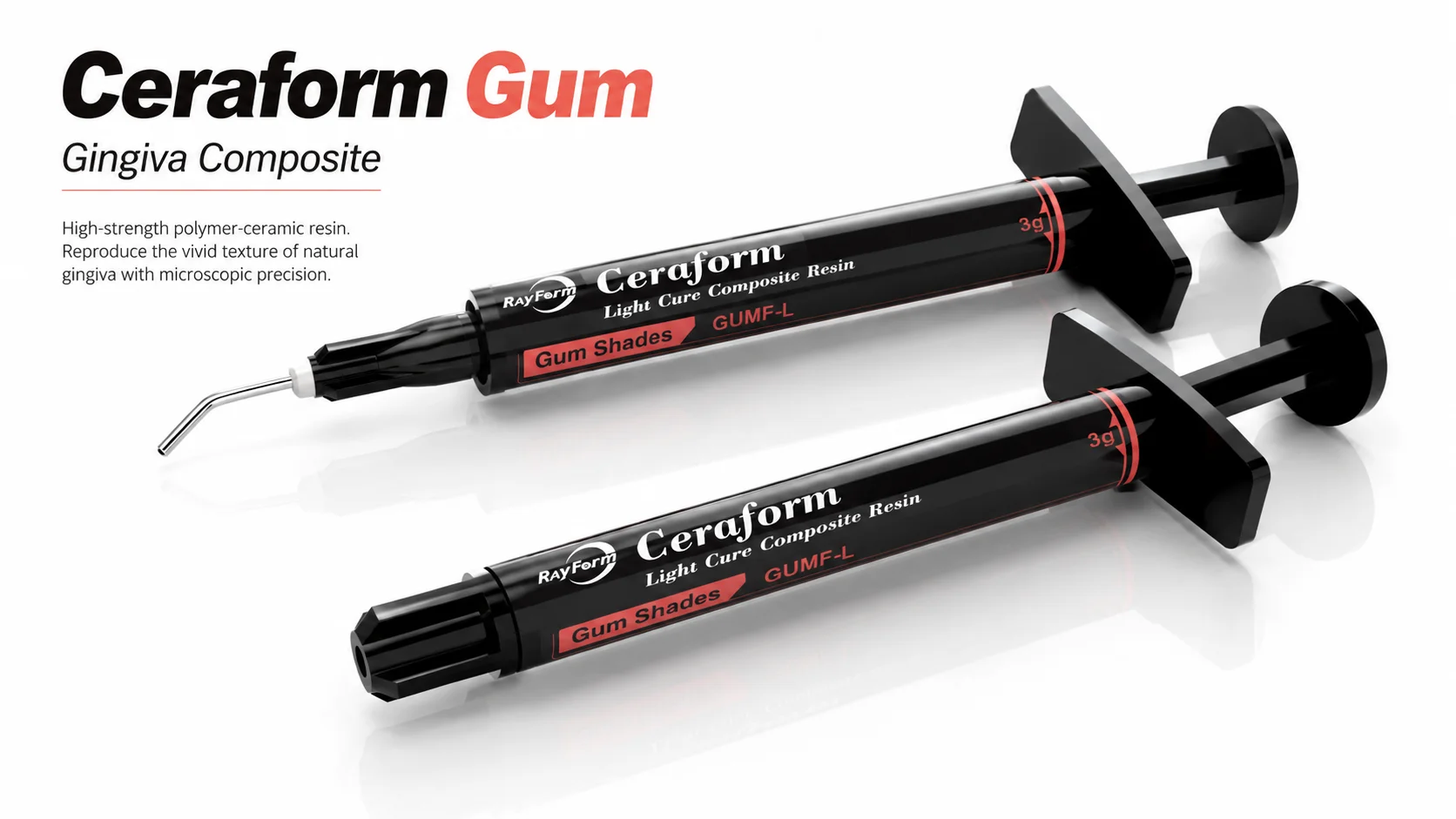
Pink-shade composites used to be a workaround for emergencies. They are now standard equipment for hybrid full-arch restorations, immediate-load implant cases, and single-tooth restorations that expose the gum line.
What to evaluate: the pink shade family’s coverage range — does it include both light and darker pigmented gum shades — and how easily it layers against natural gingiva without a sharp transition. Ceraform Gum Shades (GUM-A1, 3 g syringes) will be available for layering tests on a pink-edge model at Booth C-568.
Polishing & Finishing Systems
This is the section most composite vendors skip, but it deserves a separate booth visit. The perceived quality of a restoration is decided by the polish, not by the bulk composite. SIDEX 2026 will host several Korean and Japanese polishing-system manufacturers showing diamond-impregnated rubbers, multi-step polishing paste systems, and single-step wheel kits.
RayForm does not manufacture polishing systems — so for this category, plan to visit established polishing suppliers on the SIDEX exhibitor map directly. A useful test is to bring a polished sample from your own clinic and compare it against the booth’s claimed finish on identical resin.
How to Plan Your SIDEX 2026 Visit
A few practical patterns that make SIDEX easier:
- Pre-register online through the official SIDEX 2026 site. On-site registration adds time, and many international booths only book meetings against a verified registration code.
- Map by category, not by booth number. Restorative composite and chairside equipment exhibitors typically cluster together; lab and prosthetic suppliers tend to occupy a different zone. Building a route by category saves backtracking.
- Block your time. The most useful booths for restorative work take 20–30 minutes of hands-on testing, not a 3-minute brochure exchange. Plan three to five anchor booths per day rather than 15 quick visits.
- Bring a daylight reference. A simple A1 disc, a phone in daylight mode, or a small natural-light LED panel turns any booth’s color demo into a real test.
- Confirm meetings in advance. Most exhibitors with international sales staff will hold a 30-minute slot if you book before show day; walk-ins get whatever is left.
Where to Find RayForm at SIDEX 2026
RayForm · Booth C-568 · May 29–31, 2026
RayForm will be at Booth C-568 for the full three days, May 29 to 31. The booth is set up as a working bench rather than a brochure rack: full Ceraform Crown Shades, Gum Shades, Opaque OP-A1, and the polychromatic Tints tray are available for layering, curing, and polishing tests on shared A1 discs and a crown-and-bridge model.
To reserve a 30-minute slot in advance — recommended for distributors and lab managers — message us on WhatsApp at +86 156 7514 4495, or email contact@rayformtech.com with your preferred day. Walk-ins are welcome, but limited Ceraform + Tints sample kits are reserved for confirmed appointments through May 28.
For background on the restorative line we will be demonstrating, see our dental restorative materials page. If your interest is broader than restorative — for example, dental 3D printing resins — our dental resin catalog covers the rest of the RayForm range.
Frequently Asked Questions
When and where is SIDEX 2026?
SIDEX 2026 runs from May 29 (Fri) through May 31 (Sun), 2026 at the COEX Convention & Exhibition Center in Seoul, South Korea. The Scientific Congress runs in parallel on May 30 and 31[1].
Is SIDEX 2026 open to international visitors?
Yes. SIDEX typically draws over 2,000 international participants annually, and the Organizing Committee provides invitation letters for visa applications through the official site. Pre-registration is recommended.
What’s the difference between polymer-ceramic and nanohybrid composite?
Both are methacrylate-matrix composites, but polymer-ceramic systems typically use a higher ceramic filler load and different particle morphology, aiming for higher gloss retention and lower wear against natural enamel. Real-world performance differences depend on the specific brand and clinical protocol.
Where is RayForm’s booth at SIDEX 2026?
Booth C-568. We will be showing the Ceraform polymer-ceramic composite system, polychromatic Tints, Opaque OP-A1, and a crown-and-bridge model set up for hands-on testing. Reserve a 30-minute slot here.
Do dental tints work with composite from different brands?
Generally yes. Most surface tints used in modern restorative practice bond to any cured methacrylate-based composite. Compatibility is a question of viscosity, working time, and how the tint feathers — not chemistry.
Do I need to pre-register for SIDEX 2026?
Pre-registration is not strictly required for international visitors, but it speeds up entry, secures your name badge in advance, and is needed if you want the official invitation letter for visa purposes.
References
- Seoul International Dental Exhibition & Scientific Congress 2026 — Official General Information. Seoul Dental Association. https://eng.sidex.or.kr/eng/about/overview.php
- ISO 4049:2019 — Dentistry — Polymer-based restorative materials. International Organization for Standardization. https://www.iso.org/standard/67596.html
- Dental Composite Resins — Oral Health Topics. American Dental Association. https://www.ada.org/resources/research/science-and-research-institute/oral-health-topics/dental-composites
- SIDEX 2026 Event Page. Dental Tribune International. https://www.dental-tribune.com/event/sidex-2026/
- SIDEX 2026 Event Listing. 10Times. https://10times.com/seoulinternational-dentalexhibition-scientificcongress