Gingival Composite Bonding to Zirconia: What Dental Labs Should Check
For gingival composite bonding to zirconia, check the actual veneering surface, the complete primer–opaque–composite system, the specified curing conditions and the aging evidence. Exposed zirconia and porcelain-coated zirconia need separate consideration. Laboratory bond-strength results support evaluation of the tested combinations; they do not establish a universal recipe or clinical lifespan. [1] [2] [3]
For a dental lab, a useful evaluation starts with three questions: What surface are we bonding to? Which complete material combination is specified? What testing supports that combination?
Here, gingival composite means a gingiva-colored indirect resin composite used for laboratory layering. The discussion concerns its connection to a framework, rather than the cementation of a restoration to tooth structure. The studies measured shear bond strength (SBS): the load at failure in a shear test divided by the bonded area, expressed in megapascals (MPa). This laboratory stress value is not the fracture load of a complete restoration. [1] [3]
Identify the surface beneath the gingival composite
“Zirconia framework” describes the supporting structure, but it may not identify the surface receiving the resin system. Two earlier experiments illustrate that distinction:
| What was tested? | Kubochi et al., 2017 [1] | Fushiki et al., 2019 [2] |
|---|---|---|
| Framework surface | Air-abraded Katana zirconia, without a porcelain coating | Katana zirconia coated with feldspathic porcelain; the coated surface was then air-abraded |
| Layering materials | Ceramage gingival composite system; Palapress Vario acrylic denture-base resin was a separate comparator | Ceramage and Estenia C&B gingival composite systems |
| Conditioning | Water storage for 24 hours, followed by comparison of specimens with and without 5,000 thermal cycles | Water storage at 37°C for 24 hours; no thermal or mechanical cycling |
| Main limit | Findings apply to the tested materials and conditions, rather than clinical service life | Findings describe initial bonding; the two commercial systems differed in formulation and processing |
Palapress Vario was an acrylic denture-base resin, not a second gingival composite. Likewise, the porcelain coating in the 2019 experiment was a distinct layer over the zirconia. Keeping those distinctions visible prevents unlike systems from being grouped under a single “composite-to-zirconia” claim. [1] [2]
As a practical purchasing check, ask the supplier to identify the intended surface at the veneering area. Instructions for one substrate should not be assumed to cover another.
Specify the complete bonding system
A primer conditions the interface before subsequent resin layers are applied. An opaque is a masking layer beneath the colored composite. Both belong in the material specification, along with any activator, bonding agent and curing procedure. MDP is a phosphate functional monomer used in some primers; silane is a coupling agent used in certain ceramic bonding systems. These describe chemical components, rather than complete interchangeable products. [1] [2]
In the 2017 study, the Ceramage specimens included Pre-Opaque, Opaque GUM-O and GUM-D. The reported results therefore describe that buildup with its surface treatment, rather than GUM-D alone. The tested Alloy Primer, Clearfil Photo Bond and Clearfil Photo Bond plus Porcelain Bond Activator groups had relatively high Ceramage bond strengths both before and after thermal cycling. These were commercial formulations, not experiments that isolated a single ingredient. [1]
In the porcelain-coated study, the group labeled Clearfil Photo Bond plus Porcelain Bond Activator produced the highest initial strengths among the tested groups. Its interpretation requires care: the methods also describe additional Estenia Opaque Primer application in several groups. Ceramage and Estenia had different opaque materials and polymerization procedures. The results consequently do not isolate the effect of one primer or of heating alone. [2]
The procurement implication is to request product names and application sequence. A label such as “contains MDP” or “silane” identifies part of a formulation; it does not establish that another product will reproduce the tested combination.
Separate initial bonding from aging evidence
Thermal cycling repeatedly moves specimens between hot and cold water baths as a laboratory aging procedure. Kubochi and colleagues compared specimens before and after 5,000 cycles between 5°C and 55°C. The table below includes all eight treatment groups for the Ceramage system, keeping the composite and framework constant within this experiment. [1]
Data table 1: Ceramage on exposed zirconia
Values are mean ± standard deviation, in MPa. Standard deviation describes the spread of the measurements. Each treatment/aging condition had n = 11. All specimens first underwent 24-hour water storage at 37°C; the aged groups then received 5,000 thermal cycles. These are experimental conditions, not recommended production settings. [1]
| Treatment reported in the study | Before thermal cycling, MPa | After 5,000 cycles, MPa |
|---|---|---|
| No primer | 1.2 ± 0.7 | 0.1 ± 0.3 |
| V-Primer | 1.0 ± 0.8 | 0.2 ± 0.6 |
| MR. bond | 7.9 ± 2.1 | 6.9 ± 1.9 |
| Metal Link | 7.7 ± 3.7 | 7.1 ± 2.4 |
| Alloy Primer | 12.5 ± 2.6 | 11.1 ± 4.1 |
| Meta Fast Bonding Liner | 10.5 ± 1.7 | 4.2 ± 1.7 |
| Clearfil Photo Bond + Porcelain Bond Activator | 13.8 ± 3.9 | 11.2 ± 2.9 |
| Clearfil Photo Bond | 14.1 ± 2.9 | 12.1 ± 4.8 |
Source: Kubochi et al., Table 2, Ceramage groups. The buildup included the study's surface preparation, Pre-Opaque, Opaque GUM-O and GUM-D. The source's inconsistent percentage-reduction column is not reproduced. [1]
The authors reported significant decreases for the no-primer, V-Primer and Meta Fast Bonding Liner groups, while the other five Ceramage groups showed no statistically significant pre/post difference. The separate acrylic denture-base resin groups all showed significant reductions. [1]
“No statistically significant difference” does not establish equivalence or prove that a bond remains unchanged in service. Nor does a cycle count provide a validated conversion into years of clinical use.
Fushiki and colleagues measured initial bonding after 24-hour water storage. Their study did not test cyclic thermal or mechanical loading, and the authors explicitly identified long-term clinical stability as unknown. [2]
Data table 2: A later zirconia study with different composite systems
An independent 2025 study by Incearik and colleagues tested three gingival composite systems on titanium, zirconia and modified PEEK. The zirconia subset is shown here in full: all three composite systems on Straumann ZI, with the specified primers and opaque layers. Values are mean ± standard deviation, in MPa; n = 15 per condition. After 24-hour water storage at 37°C, the aged specimens received 10,000 cycles at 5–55°C. [3]
| Composite system and zirconia primer used | Before thermal cycling, MPa | After 10,000 cycles, MPa |
|---|---|---|
| Gradia Gum + G-Multi Primer | 16.86 ± 3.56 | 8.42 ± 3.65 |
| Anaxgum + Zircon Bonder | 12.41 ± 4.15 | 5.42 ± 3.24 |
| Nexco + SR Link | 10.52 ± 3.14 | 2.70 ± 1.72 |
Source: Incearik et al., Tables 1–2 and 4, zirconia groups. Each system also used its specified gingival opaque. All three zirconia combinations showed significant reductions after aging in this experiment. [3]
These results add evidence from another team and other material systems. They do not show that an extra 5,000 cycles alone caused a different outcome: the zirconia, primers, composites, specimen design and test conditions also differed from the 2017 experiment. Compare combinations within each study; do not combine the two tables into a brand ranking. [1] [3]
The studies also were not a controlled comparison of exposed and porcelain-coated zirconia. Their strength values cannot establish which surface is generally superior. When reviewing a supplier's data, check whether the substrate, layering system, conditioning and test method match the question your lab needs answered.
Check where the specimen failed
Adhesive failure means separation at a bonded interface. Cohesive failure means fracture within a material; a mixed failure contains both features. In the 2019 study, some treatment groups showed frequent fracture within the porcelain coating, alone or together with interfacial separation. [2]
For a lab evaluating a test report, the useful follow-up question is: Did the interface separate, or did another layer fracture first? A strength value without that information gives an incomplete picture of the tested assembly.
Five questions to send a supplier
The following checklist is an editorial recommendation for purchasing and quality records, based on the evidence above.
- Which surface does the documentation cover? Identify the zirconia product and whether the veneering area is exposed zirconia or a specified porcelain coating. Ask how that surface should be prepared.
- What is the complete material combination? Request the exact primer, activator, bonding agent, opaque and gingival composite names. Clarify which steps are required and which are optional.
- Which curing conditions apply? Request the specified equipment, program, layer limits and sequence. A time value alone leaves important parts of the workflow unspecified.
- What evidence supports this combination? Ask whether testing covers initial bonding, water storage, thermal cycling or mechanical fatigue, and whether the report identifies failure modes.
- Which document version should the lab use? Keep the applicable instructions with product and batch identification, equipment details and the actual framework surface.
For example, a job record can identify the framework, veneering-area surface, preparation method, primer/opaque/composite products, curing equipment and instruction revision. This gives the lab a concrete starting point when a material changes or a bonding problem needs investigation.
If your lab plans to veneer exposed zirconia but receives only data for a porcelain-coated surface, that documentation does not confirm the intended combination. Request the matching substrate-specific instructions and evidence before treating it as a supported production workflow. Record an unanswered question as unresolved, rather than filling the gap with another brand's experimental parameters.
Apply the findings within their scope
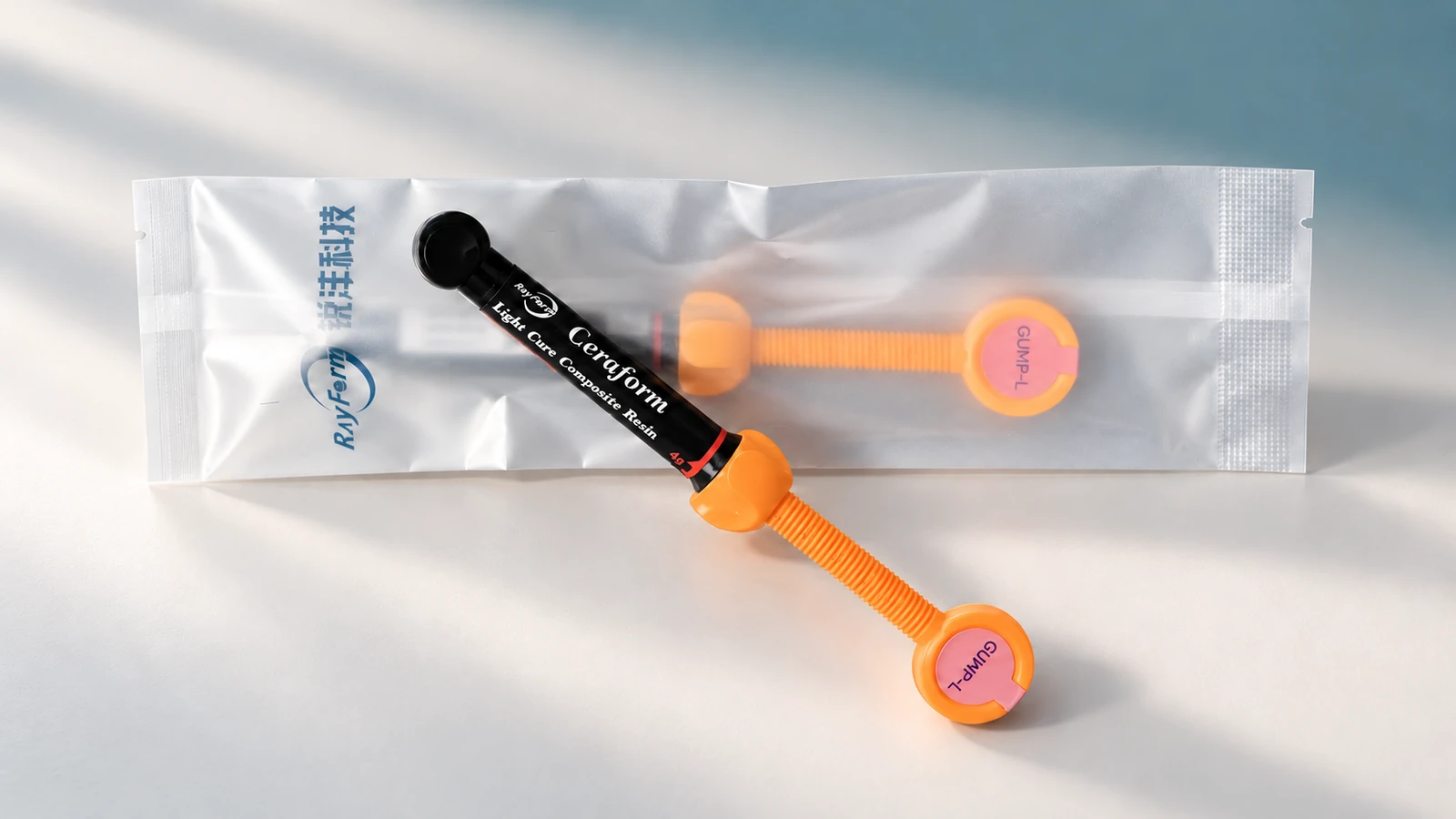
The 2017 and 2019 studies came from the same research group; the 2025 study adds an independent team and more material combinations. All three remain laboratory experiments, and none evaluated RayForm Ceraform. A Ceraform-specific workflow requires its own applicable manufacturer instructions and supporting evidence. [1] [2] [3]
When reviewing RayForm's restorative materials, contact RayForm with the framework material, actual veneering surface and intended process, and request the relevant technical documentation. Color stability and finishing are separate evaluation questions, covered in our gingival composite surface-finishing guide.
Source note: The 2017 and 2019 papers contain reporting inconsistencies in total specimen allocation, calculated reductions or selected protocol details. Those disputed fields are excluded. The numerical tables above reproduce the identified result tables, not a manufacturer processing recipe.
References
[1] Kubochi K, Komine F, Fushiki R, Yagawa S, Mori S, Matsumura H. Shear bond strength of a denture base acrylic resin and gingiva-colored indirect composite material to zirconia ceramics. Journal of Prosthodontic Research. 2017;61(2):149–157. https://doi.org/10.1016/j.jpor.2016.07.007.
[2] Fushiki R, Komine F, Kimura F, Kusaba K, Kondo T, Moriya Y, Matsumura H. Bond strengths between gingiva-colored layering resin composite and zirconia frameworks coated with feldspathic porcelain. Dental Materials Journal. 2019;38(4):547–554. https://doi.org/10.4012/dmj.2018-253.
[3] Incearik SC, Aktas G, Deniz D, Guncu MB, Özcan M. Effect of Framework Material and Thermal Aging on Shear Bond Strength of Three Different Gingiva-Colored Composite Resins. Materials. 2025;18(23):5397. https://doi.org/10.3390/ma18235397.