Gingival Composite Color Stability: Surface Finishing for Dental Labs
Evaluate a gingival composite together with its finishing process and the conditions in which it was tested. In laboratory studies, higher hardness did not consistently correspond to less staining, and adding a surface sealant to a polished composite did not improve every outcome. These findings make a documented material-and-process combination more useful than a single headline property when assessing a supplier's evidence. [1] [2]
For technicians and procurement teams working with hand-applied laboratory gingival composites, the practical questions are specific: Which shade was tested? How was it cured and polished? Was a coating added? What happened during the test, and what remains unknown?
What do color difference, roughness and gloss tell a lab?
These measurements answer different questions:
- Color difference describes the change between two color measurements. Studies may report CIELAB color difference, often written as ΔE or ΔEab, or CIEDE2000 color difference, ΔE00. Check the formula before comparing values. [1] [2]
- Surface roughness describes surface texture. Ra is a profile-based average; Sa is an area-based average. The measurement method matters when comparing results from different studies. [1]
- Gloss describes reflected light under specified measurement conditions. It is measured separately from roughness and color change. [3]
A supplier comparison should therefore identify the measured property, method and exposure conditions. A gloss photograph, a roughness value and a staining result provide different kinds of information; they should not be treated as interchangeable evidence of color stability.
Does a harder gingival composite resist staining better?
Petropoulou and colleagues tested three laboratory gingiva-colored composites: AnaxGUM Light Pink, Ceramage Body Gum-L and Gradia Gum G23. The specimens received the study's curing sequence and were polished using the procedures recommended by each material's manufacturer. Separate groups were then stored in water, coffee or red wine for 30 days. [1]
Coffee produced the greatest color change in all three tested materials. Ceramage, which had the highest measured hardness, also showed the greatest discoloration in coffee and wine under those conditions. Hardness alone therefore did not identify the least-staining material in this experiment. [1]
| Tested material / shade | Water | Coffee | Red wine |
|---|---|---|---|
| AnaxGUMLight Pink | 3.99± 1.16 | 7.88± 1.58 | 3.99± 0.34 |
| Ceramage BodyGum-L | 1.79± 1.12 | 11.37± 2.12 | 7.51± 1.04 |
| Gradia GumG23 | 1.63± 0.72 | 6.09± 1.11 | 2.67± 0.79 |
On smaller screens, swipe to see all columns.
The important qualification is the preparation method. Each material was paired with its own manufacturer-advised polishing system. The results describe those tested combinations; they do not isolate which polishing tool or paste would work best across all composites. The authors also used static immersion without intervening toothbrushing. This establishes a laboratory staining comparison, not a clinical service-life prediction. [1]
When reviewing a material proposal, ask for the tested shade and finishing sequence alongside the reported property. A result obtained with one material and polishing system is a starting point for evaluating that combination, rather than a transferable recipe for another product.
Does adding a surface sealant improve a polished surface?
The published abstract of Bozoğulları and colleagues compares conventional polishing with conventional polishing followed by a surface sealant. The study included Gradia Plus Gum, SR Nexco Paste Gingiva and Amaris Gingiva. All specimens underwent thermocycling, after which surface roughness was measured. They were subsequently stored in water or coffee for seven days for color assessment. [2]
The sealant groups had higher post-thermocycling roughness than the corresponding polished groups:
| Tested composite | Polished | Polished + sealant |
|---|---|---|
| Gradia Plus Gum | 0.29± 0.05 | 0.47± 0.09 |
| SR Nexco Paste Gingiva | 0.23± 0.06 | 0.41± 0.10 |
| Amaris Gingiva | 0.20± 0.06 | 0.39± 0.09 |
On smaller screens, swipe to see all columns.
The staining result was material-dependent. The abstract reports greater color change in the sealed groups than in the polished groups, with Gradia Plus Gum as the exception. That exception matters: the evidence does not support a blanket rule that adding a sealant always improves or always worsens color stability. [2]
Only the abstract was available for this review. It does not identify the sealant or provide pre-thermocycling roughness values. The reported comparison therefore cannot establish that thermal cycling caused a coating to peel or a surface to become rougher. It also does not test sealant application as a replacement for mechanical polishing. [2]
For a lab considering a coating, the useful supplier question is: “What evidence supports this coating on this composite, after the intended polishing and curing process?”
What can later maintenance do to the finish?
Saraç Atagün and colleagues examined Gradia Plus Gum and Crea.lign Gum specimens that had been polished and coated with Optiglaze before exposure to erythritol or sodium bicarbonate air-polishing. Surface roughness increased and gloss decreased after treatment in all tested groups. [3]
This was a maintenance-related air-polishing experiment, separate from rotary finishing at the laboratory bench. Every specimen received a coating, so the study cannot determine how otherwise identical uncoated surfaces would respond. Its findings also do not establish a universal clinical cleaning protocol. [3]
For lab-to-clinic communication, record the composite and any surface coating used, and provide the relevant manufacturer's instructions. This makes the delivered surface system identifiable when maintenance guidance is discussed.
What should the lab record before comparing outcomes?
The studies above used different materials, surface treatments, exposure conditions and measurements. A practical way to keep an internal comparison interpretable is to record the following:
- Material identity: product, shade, paste or flowable format, and batch.
- Curing conditions: curing unit, program, exposure times, layer information and the supplier instructions followed.
- Finishing process: instruments and pastes used, their sequence, and any settings specified by the manufacturer.
- Surface coating: product, application method and curing process, or a clear record that no coating was used.
- Observation conditions: baseline and later observations under consistent lighting; include the measurement method and background if using an instrument.
- Exposure history: storage medium and duration, temperature conditions, and any cleaning or wear treatment.
This is a documentation checklist drawn from the variables used in the cited studies, rather than a validated processing protocol. Its purpose is to make the comparison traceable. For example, if both the composite and coating change between two samples, the observation alone cannot tell the lab which change accounts for the difference. [1] [2] [3]
Applying these questions to RayForm Ceraform
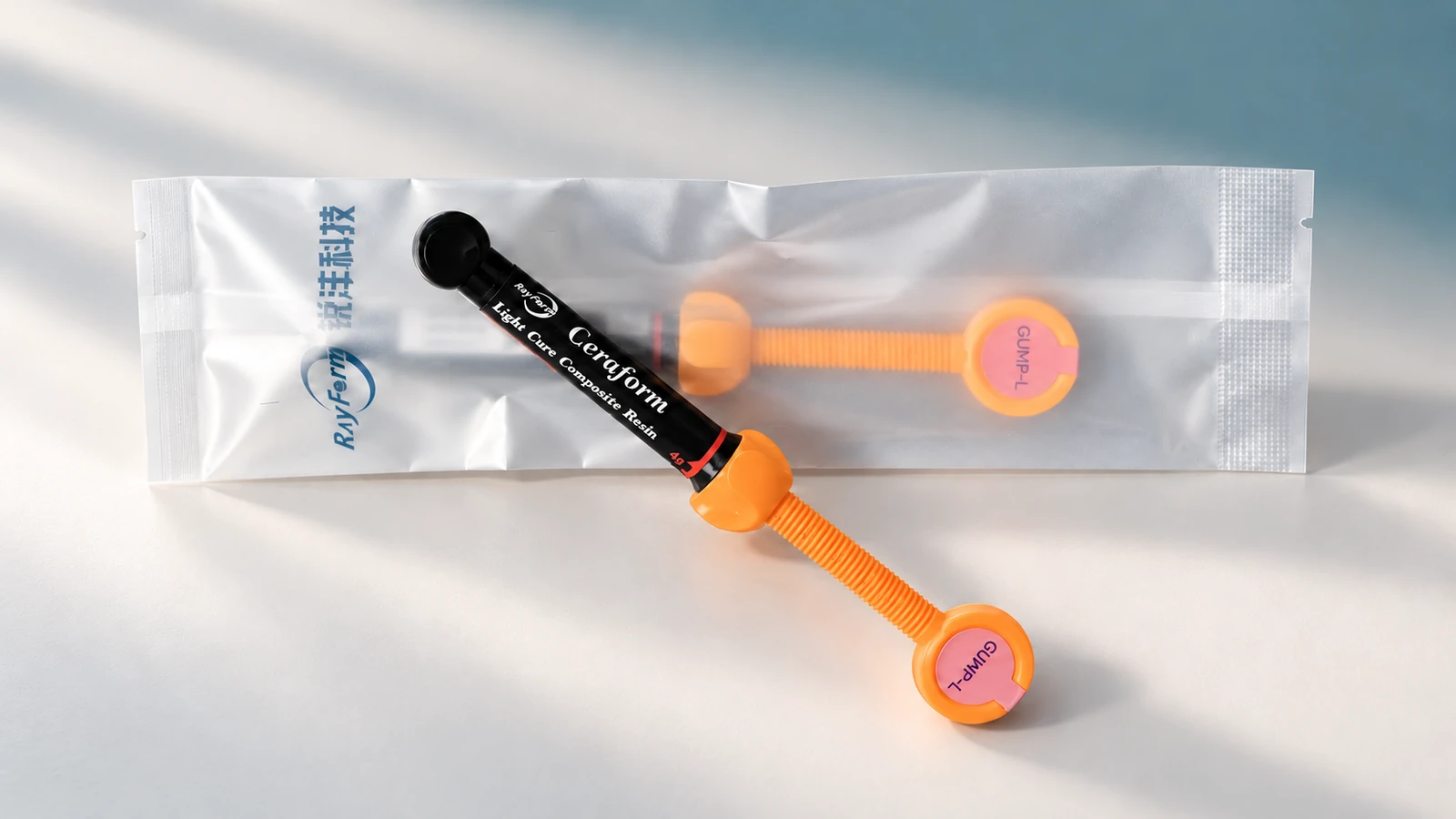
The Ceraform instruction manual identifies the system as a light-curing dental composite for indirect restorations, intended for laboratory use. It includes contouring and polishing steps. [4]
RayForm Ceraform Gum is offered as paste for shaping and contouring, and as flowable material for controlled placement, local adaptation and surface detailing. These handling descriptions should guide the product discussion; the third-party studies above did not test Ceraform.
The publicly available Ceraform manual does not provide a complete specification combining curing-unit selection, wavelength, irradiance and layer thickness, or a detailed rotary polishing sequence. Confirm the applicable settings and finishing guidance with RayForm for the material and equipment you intend to use. [4]
To discuss a laboratory application, contact RayForm with your intended material format, curing equipment and finishing process.
References
[1] Petropoulou A, Dimitriadi M, Zinelis S, Sarafianou A, Eliades G. Surface Characteristics and Color Stability of Gingiva-Colored Resin Composites. Materials. 2020;13(11):2540. doi:10.3390/ma13112540. PubMed record.
[2] Bozoğulları HN, Büyükerkmen EB, Büyüközer Özkan H. Comparison of Surface Roughness and Color Stability of Different Denture Characterizing Composite Resins: The Effect of Different Surface Treatments. Journal of Prosthodontics. 2023;32(S1):53–60. Published online in 2022. doi:10.1111/jopr.13577. PubMed abstract consulted; full text was not available for this review.
[3] Saraç Atagün Ö, Erdoğan MA, Kalyoncuoğlu ÜT. Effects of types of air polishing powders on roughness, microhardness, color, and gloss of gingiva-colored resin-based composites. Clinical Oral Investigations. 2025;29:324. doi:10.1007/s00784-025-06404-3. PubMed record.
[4] RayForm. Ceraform Instruction Manual. Two-page manufacturer document; no revision date stated. Official instruction manual. Accessed 29 October 2026.