
How to Choose the Right Dental 3D Printing Resin for Different Lab Applications
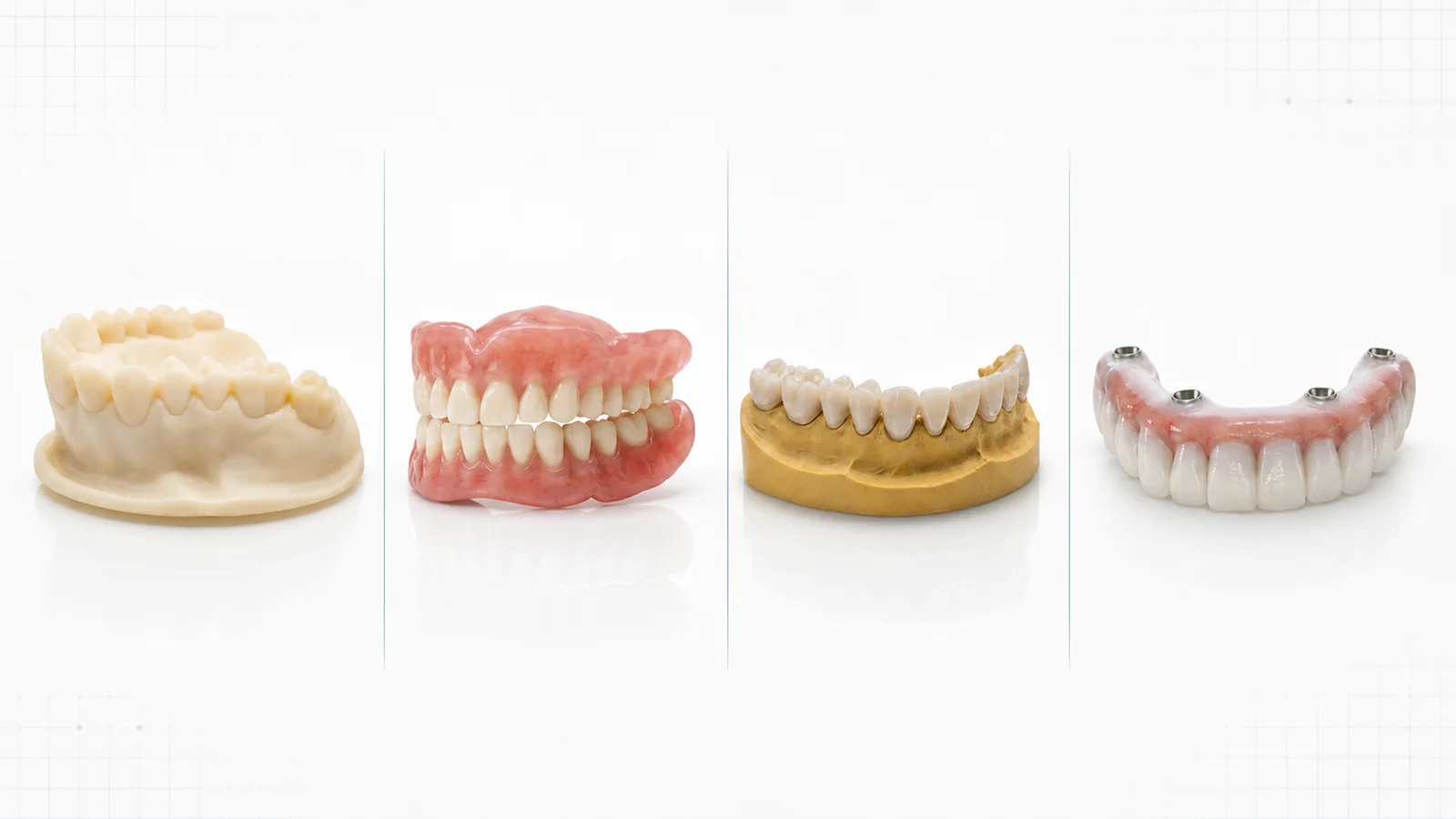
Dental laboratories are increasingly adopting 3D printing for a wide range of applications, including dental models, denture bases, crowns, implant-supported restorations, and orthodontic appliances. However, each application requires different material properties and performance characteristics.
A resin optimized for dental models may prioritize dimensional accuracy and surface detail, while materials used for restorations or appliances require additional properties such as strength, flexibility, wear resistance, or biocompatibility.
The right dental 3D printing resin should therefore be selected based on its intended application, required mechanical properties, dimensional accuracy, printer compatibility, and post-processing workflow.
This guide explores common dental laboratory applications and explains the key factors to consider when selecting resin materials for different production needs.
Why Different Dental Applications Require Different Resins
Dental 3D printing resins are developed for specific applications, and no single material can provide the ideal performance for every dental workflow.
A dental model resin is primarily designed for dimensional accuracy, surface detail reproduction, and stable handling. For thermoforming applications, additional heat resistance may be required to prevent model deformation during aligner production.
Other applications have different requirements. Denture base resins need a balance of strength and toughness to withstand repeated loading, while flexible denture materials require controlled elasticity. Restorative materials such as permanent crown resins must provide mechanical strength, wear resistance, and suitable aesthetics for their intended use.
When selecting a dental resin, laboratories should consider factors such as:
- Application requirements
- Mechanical properties
- Dimensional stability
- Surface characteristics
- Post-processing workflow
- Printer compatibility
Choosing a resin simply because it is marketed as a “dental resin” is not enough. The material should always match the specific function of the final printed part.
How to Choose the Right Dental Resin
A practical material-selection process should begin with the finished application and then compare the required properties.
1. Define the Intended Application
First determine exactly what will be printed.
Common questions include:
- Is it a working model or a patient-contact appliance?
- Is the part temporary or intended for long-term use?
- Will it experience heat during thermoforming?
- Will it be exposed to biting or chewing forces?
- Does the part need to flex during placement or removal?
- Will it be bonded to teeth, denture teeth, or an implant framework?
- Does it require polishing, staining, or characterization?
This first step eliminates materials that are not designed for the application.
For example, a model resin should not be selected for a permanent crown simply because it prints accurately. A rigid denture base resin should not replace an invisible denture material when controlled flexibility is required.
2. Compare Strength Requirements
Strength should be evaluated according to the forces applied to the finished part.
High strength is especially important for:
- Denture bases
- Permanent crowns
- Implant-supported restorations
- Full-arch hybrid dentures
- Parts with thin structural sections
However, “stronger” does not always mean “more suitable.”
A material with high hardness can still be brittle. A resin with excellent tensile strength can still perform poorly under repeated bending or impact. Laboratories should consider the type of loading rather than comparing a single data-sheet value.
Relevant properties can include:
- Flexural strength
- Tensile strength
- Impact resistance
- Fracture resistance
- Surface hardness
- Wear resistance
For functional restorations, the complete combination of these properties is more useful than one maximum figure.
3. Evaluate Toughness and Flexibility
Toughness describes how well the material resists cracking or sudden failure. Flexibility describes how much it can bend before returning to its intended shape.
These properties are especially important for:
- Invisible denture bases
- Thin denture sections
- Removable appliances
- Components with undercuts
- Parts that undergo repeated insertion and removal
Too much rigidity can make a thin part prone to fracture. Excessive flexibility can reduce positional stability or functional support.
The laboratory should therefore match the material’s flexibility to the appliance design instead of choosing the softest or hardest available resin.
4. Determine the Required Accuracy
Not every printed dental part requires the same accuracy.
Study models can tolerate a different level of dimensional variation from:
- Implant analog models
- Crown and bridge models
- Restorative margins
- Full-arch implant-supported restorations
- Models used for thermoforming
- Thin-fitting dental appliances
Accuracy depends on more than printer resolution. It is also affected by:
- Resin shrinkage
- Exposure calibration
- Print orientation
- Support placement
- Washing time
- Drying
- Post-curing
- Part thickness
- Storage conditions
A printer advertised with a small pixel size does not automatically produce an accurate final part. The resin and the entire workflow must be calibrated together.
When precision is critical, laboratories should measure the completed and post-cured part rather than relying only on the appearance of the fresh print.
5. Confirm Printer Compatibility
Before ordering resin, verify that it is compatible with the laboratory’s equipment.
Check:
- Printer technology
- LCD, MSLA, DLP, or SLA compatibility
- 385 nm or 405 nm wavelength
- Available exposure profiles
- Recommended layer thickness
- Build platform and vat requirements
- Post-curing equipment
- Open-system or closed-system restrictions
RayForm’s dental resin portfolio is designed primarily for open-system LCD, MSLA, and DLP dental printers, with parameter profiles available for multiple printer platforms.
Two printers using the same wavelength can still require different exposure times because their light intensity and optical systems are not identical.
The laboratory should obtain a starting profile from the supplier and then verify it with its own printer, environment, and production geometry.
6. Review Post-Processing Requirements
Washing and post-curing affect the final strength, accuracy, surface quality, and stability of printed parts.
Before selecting a resin, compare:
- Required cleaning solvent
- Recommended washing time
- Drying procedure
- Support-removal sequence
- Post-curing time
- Curing wavelength
- Finishing and polishing requirements
- Storage conditions
- Required thermal treatment
A resin that prints quickly can still create a slow workflow if it requires complicated cleaning or finishing.
For high-volume laboratories, post-processing efficiency should be evaluated together with print speed and resin price.
7. Check Documentation for the Intended Use
For patient-contact appliances and long-term restorations, the laboratory should review the documentation supplied for the exact material and application.
Depending on the destination market and intended use, relevant documents can include:
- Technical Data Sheet
- Safety Data Sheet
- Instructions for Use
- Biocompatibility documentation
- Batch traceability information
- Shelf-life and storage requirements
- Regional registration or compliance information
A general dental designation does not confirm suitability for every intraoral indication.
Dental Resin Selection Guide by Application
Dental Model
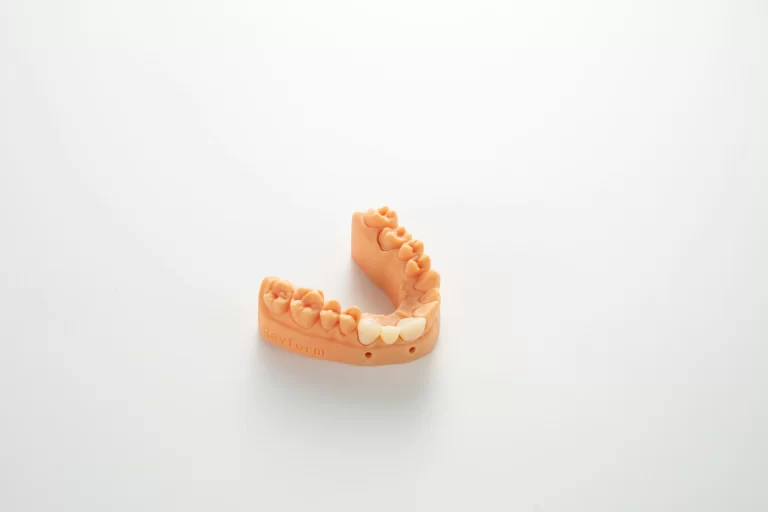
Dental models are used for diagnostic evaluation, treatment planning, restorative fitting, implant model assembly, and clear aligner thermoforming.
Although these applications all involve printed models, their material requirements are different.
A routine study model normally prioritizes:
- Accurate reproduction of tooth anatomy
- Smooth surfaces
- Fast printing
- Easy cleaning
- Sufficient handling strength
- Low production cost
Implant and restorative models place greater emphasis on:
- Stable implant analog positioning
- Accurate sockets and margins
- Low shrinkage
- Resistance to cracking during assembly
- Long-term dimensional stability
Models used for clear aligner thermoforming must also resist the heat and pressure applied during forming. A resin that performs well for a presentation model can still soften or deform when a heated aligner sheet is pressed over it.
RayForm offers model materials for high-precision implant applications, water-washable model production, and heat-resistant thermoforming workflows. Its dental resin range is designed for compatible LCD and DLP systems operating at 385 nm or 405 nm.
The correct model resin should therefore be selected according to how the printed model will be used after printing, rather than according to appearance alone.
Denture Base
Denture base production requires a different balance of properties from dental model printing.
A conventional rigid denture base should maintain its shape under functional loading. Important characteristics include:
- High flexural strength
- Fracture resistance
- Dimensional stability
- Surface hardness
- Wear resistance
- Reliable polishing
- Stable gingival appearance
- Compatibility with the intended denture teeth and bonding process
RayForm Denture Base Resin is designed for full dentures, partial dentures, and implant-supported denture bases, with emphasis on strength, hardness, precision, wear resistance, and polishing performance.
Flexible or invisible denture bases serve a different purpose. They need to bend without cracking while recovering their intended shape after insertion or removal.
Key requirements include:
- Controlled flexibility
- Tear resistance
- Fatigue resistance
- Toughness around thin areas
- Comfortable adaptation
- Smooth finishing
- Resistance to repeated deformation
RayForm Invisible Denture Base Resin is developed for flexible denture bases and transitional restorative applications. Its distinguishing features are elasticity, toughness, fatigue resistance, and a longer flex life rather than maximum rigidity.
The choice between rigid and flexible denture resin should be based on the prosthetic design and expected function. A flexible material is not automatically better for every denture, and a rigid base resin should not be used where repeated controlled flexing is required.
Permanent Crown
Permanent crown resin must reproduce fine restorative details while remaining stable under biting, chewing, moisture, staining agents, and routine cleaning.
Compared with temporary restorative materials, permanent crown resin generally requires greater attention to:
- Occlusal load resistance
- Fracture resistance
- Wear resistance
- Marginal accuracy
- Surface polish and gloss
- Color stability
- Bonding performance
- Water absorption
- Long-term dimensional stability
Ceramic-filled resin formulations can increase hardness, wear resistance, and tooth-like surface characteristics. However, a higher filler percentage is not the only factor that should be considered.
The laboratory should also evaluate:
- The restoration type
- Anterior or posterior placement
- Wall thickness
- Occlusal design
- Printer and exposure settings
- Washing and post-curing procedures
- Finishing and bonding requirements
RayForm offers Permanent Crowns Resin in 20% and 55% ceramic-filled formulations. The 20% material focuses on anti-fracture performance, gloss, and wear resistance, while the 55% version is positioned for greater strength and long-term restorative durability.
Laboratories should select between the formulations according to the required restoration performance and validate the complete printing and finishing workflow before regular production.
Fixed Hybrid Denture
Fixed hybrid dentures and full-arch implant-supported restorations experience more complex functional loading than a single dental crown.
The material must support:
- Full-arch dimensional accuracy
- Resistance to occlusal loading
- Fracture resistance
- Wear resistance
- Stable bonding to the supporting framework
- Stain and chemical resistance
- Surface polishability
- Long-term color stability
The restoration design, framework material, connector dimensions, tooth arrangement, and bonding process all influence the final result. Material strength alone cannot compensate for inadequate restorative design or incomplete post-curing.
RayForm Fixed Hybrid Dentures Resin is developed for full-arch implant-supported restorative workflows. Its main characteristics include flexural strength, abrasion resistance, bonding performance, chemical resistance, and color stability.
This category should be treated separately from standard denture base resin because the printed restoration is expected to perform a different structural and functional role.
RayForm Resin Recommendations by Application
After the application and performance requirements have been defined, laboratories can compare the corresponding RayForm materials.
| Lab Application | Recommended Material | Distinguishing Characteristics |
|---|---|---|
| Orthodontic and diagnostic models | Water Washable Dental Model Resin | Water-based cleaning, low odor, low shrinkage, and efficient routine model production |
| Implant and restorative models | High Precision Implant Model Resin | Designed for accurate implant analog positioning, detailed margins, and dimensional stability |
| Clear aligner models | High Temp Resistant Model Resin | Heat resistance, high surface hardness, low warpage, and stability during hot-pressure forming |
| Full, partial denture bases | Denture Base Resin | Rigid base material with strength, hardness, wear resistance, and polishing performance |
| Flexible and invisible denture bases | Invisible Denture Base Resin | Controlled elasticity, toughness, tear resistance, and fatigue resistance |
| Permanent crowns | Permanent Crowns Resin 20% | Ceramic-filled formulation focused on anti-fracture performance, gloss, and wear resistance |
| Higher-load permanent restorations | Permanent Crowns Resin 55% | Higher ceramic filler content with greater strength and long-term restorative durability |
| Full-arch implant-supported restorations | Fixed Hybrid Dentures Resin | Occlusal-load resistance, abrasion resistance, bonding performance, and color stability |
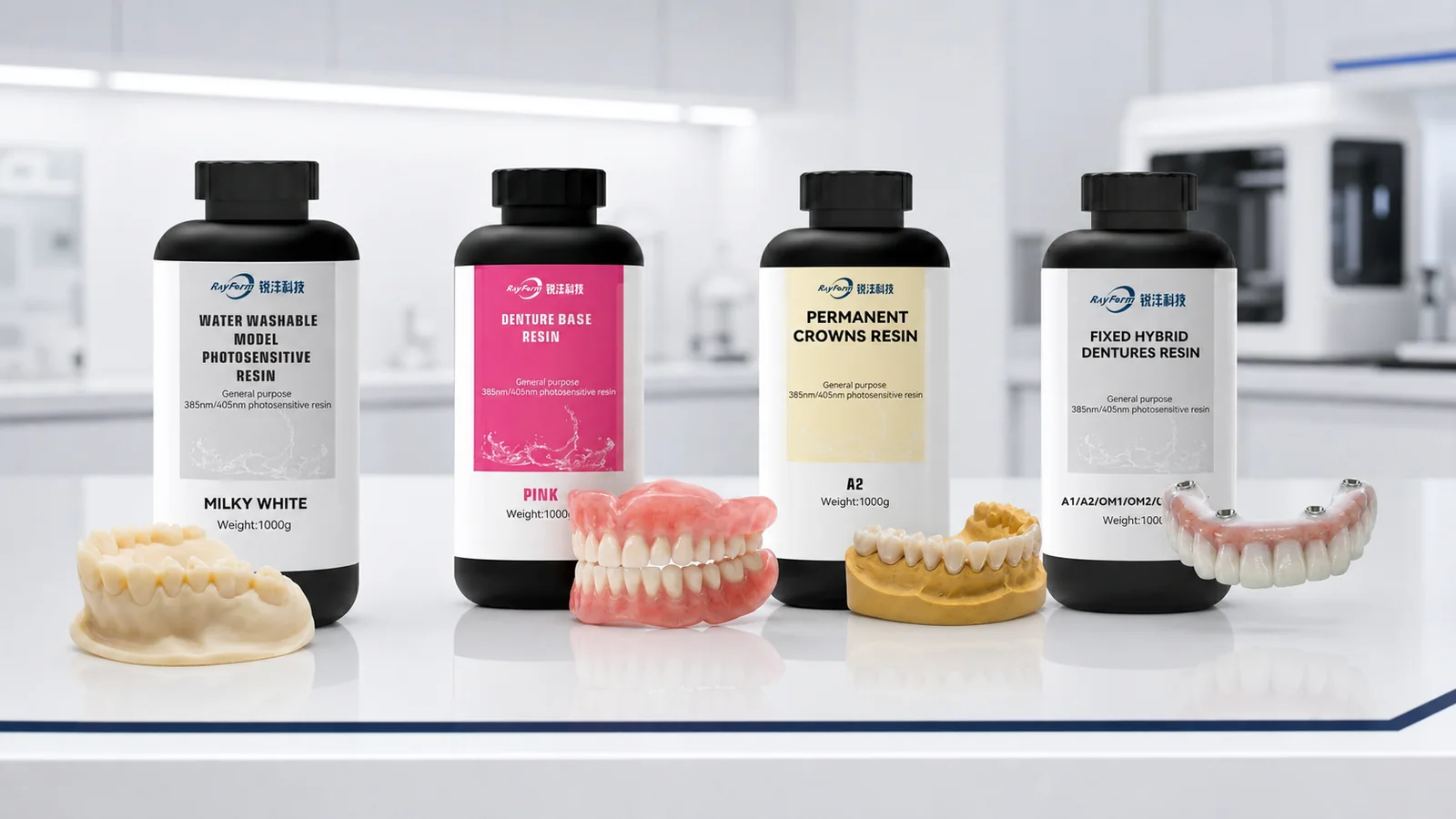
RayForm provides a broader dental material portfolio, but the products in this table represent several of the most common model, denture, and restorative workflows. The company also provides technical data sheets and printer profiles through its support center.
Common Resin Selection Mistakes
Several selection errors can increase failed prints, remakes, and material waste.
Choosing by price per bottle
The lowest resin price does not necessarily produce the lowest cost per completed case. Washing time, failed prints, polishing labor, sheet waste, and remakes should also be included.
Comparing only hardness
Hardness does not explain flexibility, fatigue resistance, fracture toughness, or impact performance.
Using one resin for all model applications
Study models, implant models, and thermoforming models have different requirements for accuracy, heat resistance, and dimensional stability.
Ignoring printer calibration
A high-performance resin can still produce inaccurate parts when exposure, orientation, or post-curing settings are incorrect.
Skipping production validation
A single successful print does not confirm consistency across multiple bottles, printers, build-platform positions, and production days.
A Practical Resin Validation Process
Before introducing a new material into regular production, laboratories should complete a controlled evaluation.
Step 1: Select a Representative Case
Choose a design that includes the critical features of the intended application, such as thin margins, implant sockets, denture extensions, undercuts, or full-arch geometry.
Step 2: Use the Supplier’s Starting Parameters
Begin with the recommended printer profile rather than copying settings from an unrelated resin.
Step 3: Complete the Full Workflow
Print, wash, dry, remove supports, post-cure, finish, and polish the part according to the intended production process.
Step 4: Inspect Functional Performance
Evaluate:
- Dimensions
- Fit
- Surface quality
- Margins
- Strength
- Flexibility
- Polishing response
- Resistance to cracking
- Stability after storage
Step 5: Repeat the Test
Repeat production in different build-platform positions and, where possible, with more than one resin batch.
Step 6: Record the Approved Process
The approved printer, resin, exposure, orientation, washing, curing, and finishing settings should be recorded in the laboratory’s standard operating procedure.
Conclusion
Choosing the right dental 3D printing resin begins with the intended application.
Dental models require accuracy and dimensional stability. Thermoforming models also need heat resistance. Rigid denture bases require strength and hardness, while invisible denture bases need toughness and controlled flexibility. Permanent crowns require wear and fracture resistance, and fixed hybrid dentures must withstand full-arch functional loading.
Laboratories should compare materials according to:
- Application
- Strength
- Toughness
- Flexibility
- Accuracy
- Printer compatibility
- Post-processing requirements
- Required documentation
The best resin is not simply the material with the highest strength or the lowest price. It is the material that performs consistently throughout the laboratory’s complete printing, post-processing, finishing, and delivery workflow.