
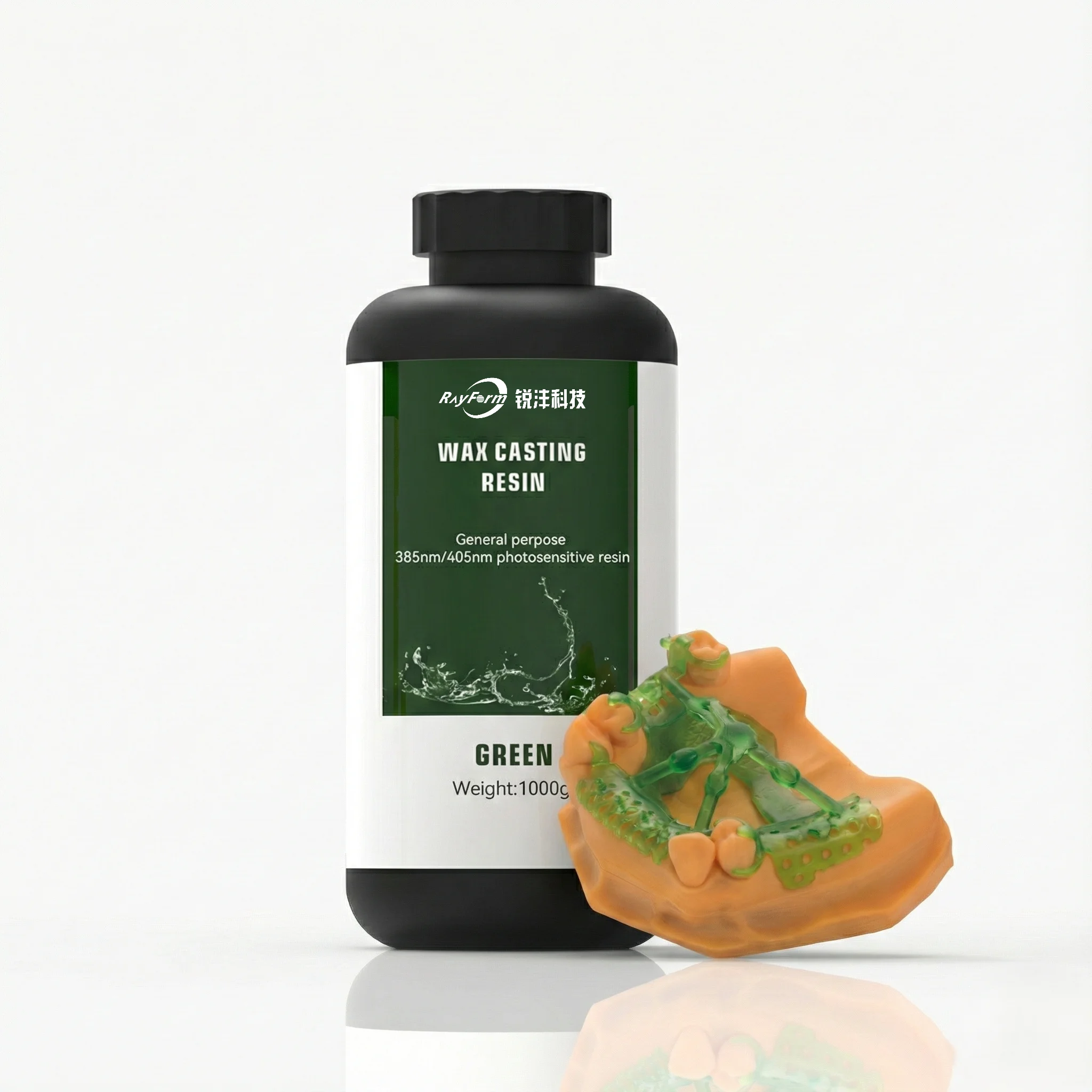
Castable Resin for Dental Casting
Key Features
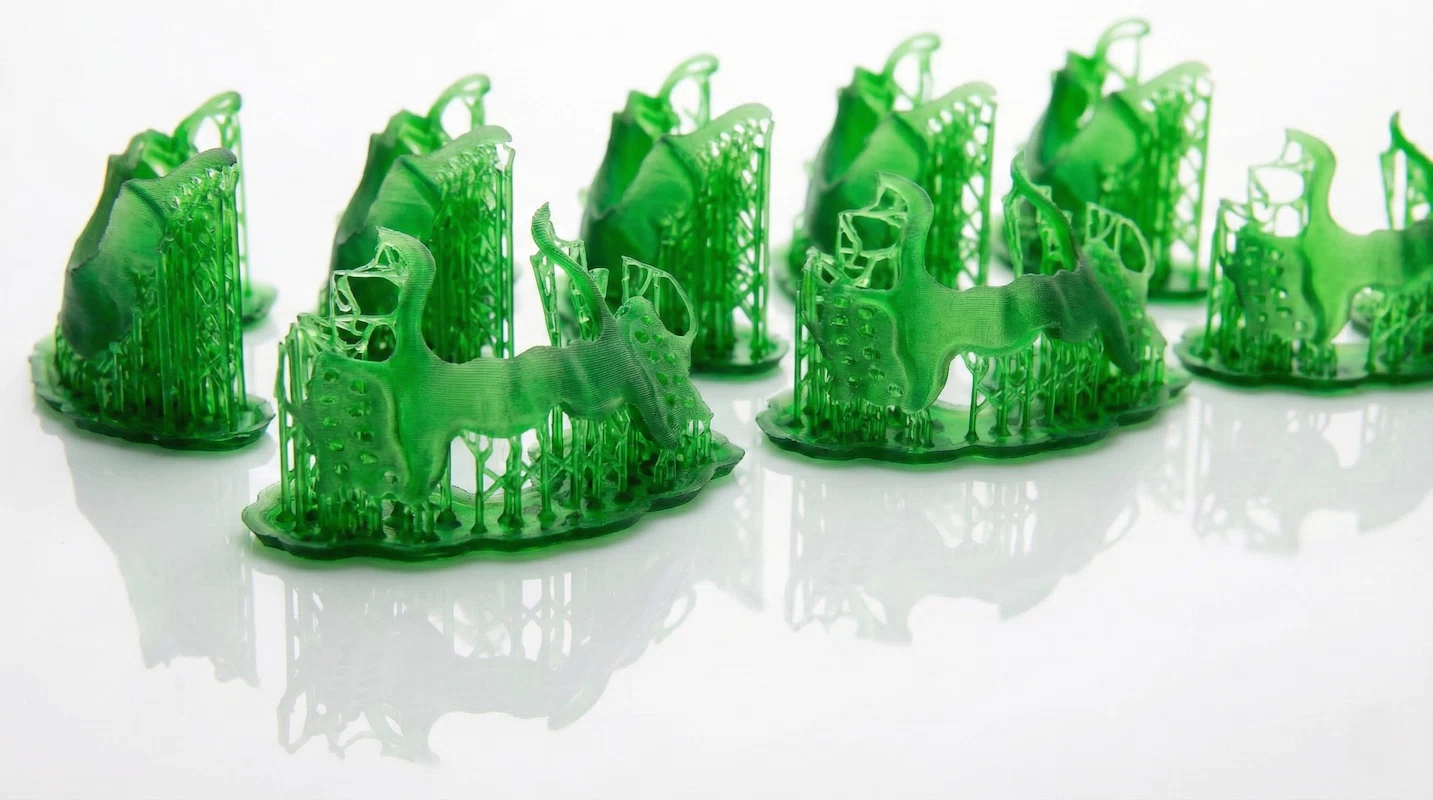
RF-ZZ-07 is a green castable 3D printing resin for digital dental casting patterns. The TDS characterizes it by high precision, good hardness and castability, with fast combustion and residual ash below 0.1%. In the casting workflow, cleaned parts can usually proceed after support removal without secondary curing; for a non-casting purpose that requires additional toughness, the TDS permits an optional 5-minute UV cure.
Basic Performance
| Properties | Unit | Standard | Result |
|---|---|---|---|
| Density | g/cm³ | ASTM D792 | 1.05–1.15 |
| Viscosity | mPa·s | ASTM D445 | 100–200 |
| Hardness | Shore D | ASTM D2240 | 87–90 |
| Flexural Strength | MPa | ASTM D790 | 90 |
| Flexural Modulus | MPa | ASTM D790 | 1300 |
| Heating Temperature | °C | — | 850–1000 |
| Residual Ash Content | % | — | <0.1 |
Printing Parameters
The following LCD/DLP settings are the six printer reference profiles listed in the RF-ZZ-07 TDS. Treat them as starting values and verify exposure and motion settings on your own printer and casting workflow.
| Printer | Exposure (s) | Base Exp. (s) | Base Layers | Lift Height (mm) | Lift Speed (mm/min) | Retract Speed (mm/min) |
|---|---|---|---|---|---|---|
| Phrozen Sonic Mini 8K S | 6 | 25 | 3 | 4+4 | 60+180 | 180+60 |
| Creality Halot-MAGE Pro | 2 | 20 | 3 | 8+2 | 120+240 | 240+180 |
| Elegoo Saturn 4 Ultra | 5 | 25 | 3 | Default standard parameters of the device | ||
| Anycubic Mono 4 Ultra | 5 | 25 | 3 | 4+4 | 120+240 | 240+120 |
| Elegoo Saturn 3 Ultra | 5 | 25 | 3 | 4+4 | 120+240 | 120+240 |
| Anycubic M7 Pro | 4 | 20 | 3 | 4+4 | 120+180 | 180+120 |
Post-Processing & Storage
-
1
Wash – Clean the model using isopropyl alcohol (IPA) in an ultrasonic cleaning machine. Avoid high-frequency shock or forceful brushing to protect fine surface details.
-
2
Dry – Thoroughly blow the model dry with a hair dryer or similar tool.
-
3
Remove Supports – Remove supports after IPA cleaning and complete drying. For the casting workflow, parts usually proceed without secondary curing.
-
4
Conditional UV Cure – If a non-casting purpose requires additional toughness, the TDS permits a 5-minute UV cure. This is not presented as a required casting-workflow step.
Storage
Store below 25°C in a cool place away from direct sunlight. Keep away from visible light to prevent resin polymerization and gelation.
Safety
Eyes: Flush with clean water for at least 20 minutes and seek medical attention immediately. Skin: Remove contaminated clothing and wash thoroughly with soap and water. Not approved for food, drink, or medical application on the human body. See MSDS for details.
LCD / DLP Printer Reference Profiles
The TDS lists reference settings for the following six LCD/DLP printers. A listed profile is a starting point, not a claim of universal settings across every machine or workflow.
For another printer, establish and verify a dedicated exposure profile before production.
Dental Laboratory Casting Applications
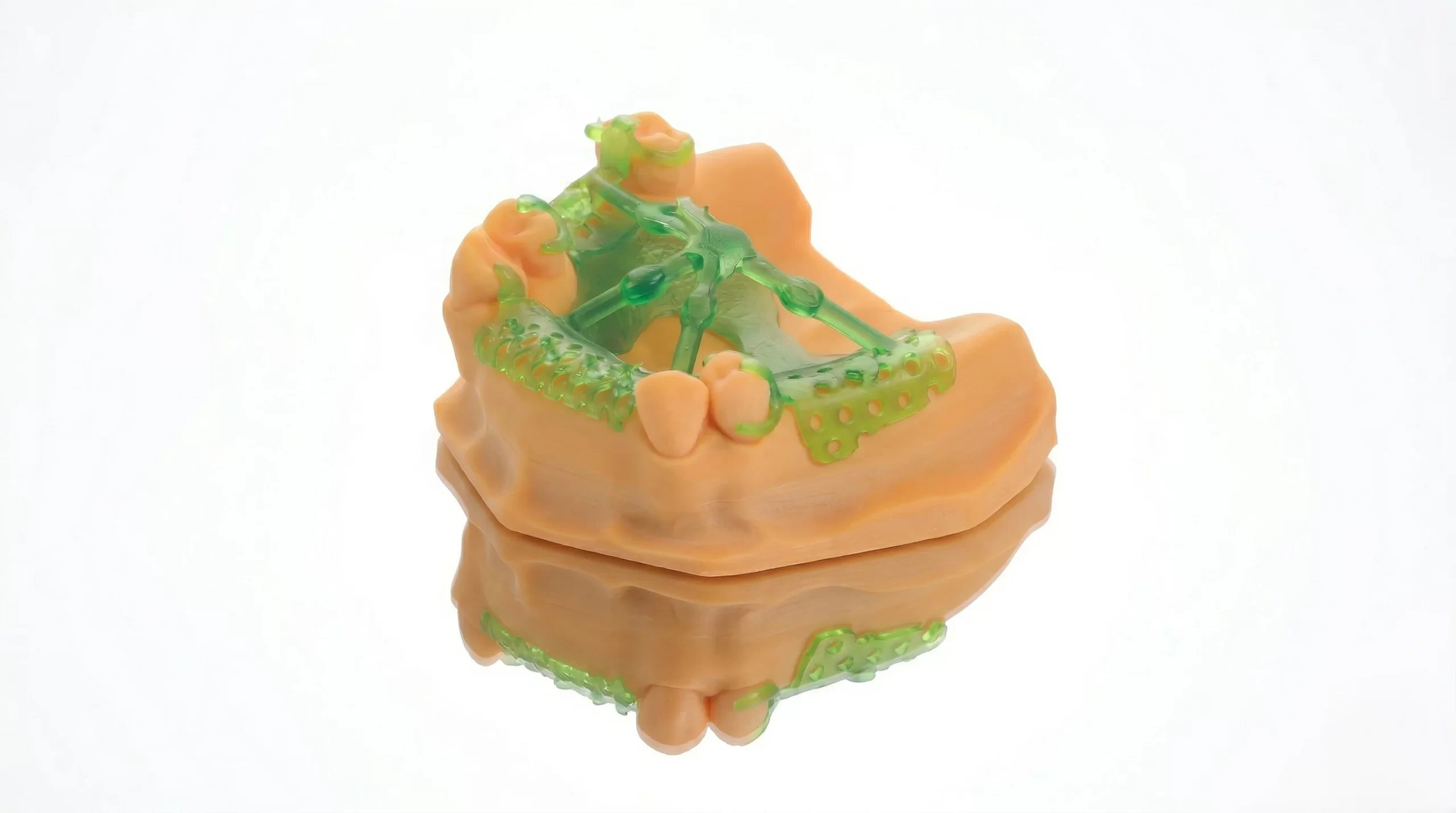
RF-ZZ-07 is used to print dental casting patterns and casting blanks for precision casting workflows, including patterns for denture steel supports. Investment, alloy and furnace cycles should be verified by each laboratory.
RF-ZZ-07 Technical Information
Plan a controlled trial with the TDS properties, the listed printer starting profile and the post-processing sequence shown on this page.
Material profile
Green castable resin with 87–90D hardness, 100–200 mPa·s viscosity and residual ash below 0.1%.
Printer starting point
Reference settings are provided for six named LCD/DLP printers; verify them on the actual machine before production.
Cleaning sequence
Use gentle, low-frequency ultrasonic IPA cleaning, dry completely and then remove supports.
Casting workflow
The TDS lists an 850–1000 °C heating range. Validate the investment, alloy and furnace cycle used by the laboratory.
Frequently Asked Questions
- QWhat is RF-ZZ-07 used for?
It is a castable 3D printing resin for dental casting patterns and casting blanks in precision casting workflows. - QWhat residual ash and heating range does the TDS state?
The TDS states residual ash below 0.1% and a heating-temperature range of 850–1000 °C. - QDoes the casting workflow require secondary curing?
Cleaned parts usually proceed after support removal without secondary curing. If a non-casting purpose needs additional toughness, the TDS permits an optional 5-minute UV cure. - QWhich printer technologies are covered?
The TDS covers LCD and DLP printing and lists six printer-specific starting profiles on this page. - QHow should printed patterns be cleaned?
Clean them in IPA with gentle, low-frequency ultrasonic action, avoid forceful brushing, dry fully and then remove supports. - QHow should the liquid resin be stored?
Store it below 25 °C in a cool place protected from direct sunlight and visible light. - QCan the listed heating range replace a laboratory burnout program?
No. The TDS lists an 850–1000°C heating range and residual ash below 0.1% as material references. A casting trial should still evaluate the investment, alloy and actual furnace cycle used by the laboratory. Use these resin data when planning the trial; they do not establish one universal burnout program for every casting system. - QHow do retail and B2B resin purchasing differ?
For retail resin purchases, open the matching store product. For bulk supply or distributor pricing, send a B2B resin inquiry. Include the resin, required quantity, printer model and target market so the order and current material documentation can be matched to your workflow.
Evaluate RF-ZZ-07 for your dental casting workflow
Tell RayForm your printer, material application and expected volume. Request a sample, TDS, starting parameters and a current supply quotation.
Explore More Materials
Compare RayForm resins by printed component, cleaning process and material data to select a laboratory production workflow.